Showing posts with label Music. Show all posts

Sunday, 25 June 2023

"Tango is terrible"

'Tango Macho'


After the Rosarinos had played their set of live music we chatted. She had got him playing tango music. She danced, he didn't. I asked them if they found differences in milongas in different places but they mentioned nothing in particular.

I mentioned the story from Buenos Aires that demonstrated the near zero tolerance for same sex dancing there is (or was, in 2016) in the traditional milongas there.

She was amazed that such things still happened.

I was amazed she didn't know that.

Tango is terrible, he said, with a sorrowful shake of the head. I wasn't sure if there was irony there.

What do you mean?

The lyrics, they are awful. He meant sexist.

Ultimately, sexism, machismo is about control.

And yet you travel the world, playing tango music!

Ah, but not the lyrics. There are no lyrics when we play, he grinned.

Monday, 13 March 2023

Bandolera / Ojos negros

Wikimedia


The lovely song, Ojos Negros, famously interpreted by Francisco Canaro's tango orchestra (1935) with the singer Roberto Maida has a long history - there is an article about this by Dmitry Pruss.

Many numbers we think of as "tango" or "milonga" have lives outside our world.  The Puerto Rican pianist Noro Morales also covered Dark Eyes in an interesting mambo version (1964) as well as Niebla del Riachuelo (1960).  What we think of Canaro's Milonga Sentimental was covered by the salsa orchestra El Gran Combo de Puerto Rico, in 1982.  Recently I heard Las Cuarenta - the best danceable tango versions are by Canaro/Maida (1941) and Lomuto / Omar (1937) - in a bolero version by Rolando Laserie.  I particularly like Lucio Demare's 1968 piano versions of many famous tangos.  They have a retrospective air which never falls into sentimentality.

During that difficult time I was listening to a lot of salsa. Bandolera, by Héctor Lavoe contains a long section of improvisation in which Ojos Negros, is referenced musically (5.27).  I asked Camilo if he could identify any other pieces in that improvisation.  He heard Historia de un amor (4.09) and Obsesión (5.16).  I would be interested if anyone can identify anything else.

The two he mentioned are apparently both boleros, love songs, which is interesting in the context of Bandolera, a song whose lyrics are in part, shockingly, about a man hitting a woman:

Pau, pau, pau
Te voy a dar
Te voy a dar una pela
[...]
Pau, pau, pau
Te vuelvo a dar
Te voy a dar pa' que aprendas
[...]
Te voy a pegar, te voy a pegar, te voy a pegar, te voy a pegar, te voy a pegar

Some of the salsa lyrics I heard at that time were apt to the situation I was trapped in:

Y por los celos, los celos, los celos
A mí el corazón me arde, me arde
Y por los celos, los celos, los celos
A mí el corazón me arde, me arde

(Gitana, Willie Colon)

There was a lie, and attempts to manipulate situations with people I dance with.

Quien dice una mentira dice dos
Y dice cien, se inventa mil
Dice un millón
El ser que ya nació para engañar
Te engaña a ti, me engaña a mí
Me engaña a mí


(Bandolera, Héctor Lavoe)

Because of these interventions, I was losing those dance partners.  I dance with new people who come to the práctica and introduce them to others, that they may discover the dance and there is pleasure in that, but people dance tango many ways and there are few enough who dance for and with the kind of musicality and connection that I enjoy.  These I value. 


So I drew a line.


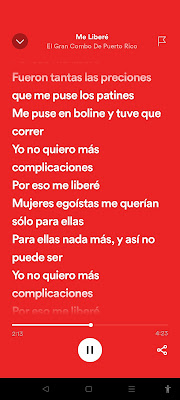
(Me liberé, El Gran Combo de Puerto Rico)

Blocking communication channels was easy, and so, I thought, effective. I had seen enough and had caught the scent of danger, even if I didn’t yet know the gravity of it.

Aléjate bandolera
Aléjate bandolera
Aléjate bandolera

(Bandolera)


It was sad…

Cuando en el alma se siente un dolor
Por la traición que te brinde un amigo /
En ese momento piensa que todo es posible

(Indestructible, Ray Barretto)


…but it was also scary.

I was contorting my life to avoid harassment. I cancelled my first práctica and an invitation to a party. They said they weren't going, so I could go, tranquilamante. But my trust was shot, I didn't and I cancelled the second práctica. Then I understood they were quitting tango. I felt huge relief, published the next práctica and thought I was free.

Me liberé, me liberé
Gracias a Dios, me liberé
Me liberé, me liberé
Gracias al cielo, me liberé
Me liberé de mujeres perversas que quieren hacer mi vida de cuadritos
Me liberé de chicas sin escrúpulos,

(Me liberé, El Gran Combo de Puerto Rico)

I was wrong.  A month on, while much improved, the physical effects of that day of imposition, control and entrapment are still with me. The weeks leading up to that day are associated now with these salsa numbers and, by association, Ojos negros, particularly the chilling line, "ojos negros, que dominan"With luck, one day some great dance will replace them.


Monday, 27 February 2023

Refuge

Mick Lisson


Sometimes refugees from class come to the práctica.  It is a great pleasure and privilege to have them.  Some of these say they love the freedom of following the music. I guess that's in contrast to the tyranny of steps.

A: But what's this that's playing now?

B:  This is vals, Argentinian waltz.

A:  Not tango?

B:  Right. We play tango, vals and milonga, and maybe candombe in the social dance. 

A:  All different types of music? 

B:  Yeah, with different rhythms.

A:  And does vals have its own steps?

B:  Maybe more like a different energy.  You often see it danced with more turns because, well, I guess that circular energy goes with the music, no? Didn't you learn about the different types of music, in class?

A: No.

B: The ronda? 

A:  No. 

B:  About tandas, cortinas? 

A:  No.

B:  So what did you learn?

A:  Just a couple of steps, often without music.

Thursday, 23 February 2023

Music, pause, silence

This year I came across Miloš Karadaglić playing classical guitar.  It is his most understated playing, the playing that includes pause and silence, that I most enjoy.  The local guy I met in Salon Canning, was the one who told me about Gavito talking about the silence between the steps:  El tango está entre paso y paso, allí donde se escuchan los silencios y cantan las musas.  (Also referenced here)

Gavito, also said, apparently something like: "A good dancer is one who listens to the music. We dance the music not the steps. Anyone who aspires to dance never thinks about what he is going to do. What he cares about is that he follows the music." I can't find a reliable Spanish version or source for this but I am glad somebody said it, because "anyone who aspires to dance never thinks about what he is going to do" rings true for me, when I dance in the guy's role. 

In the woman's role I can tell instantly when a guy is thinking his dance and when he is not.  Based on dancing since 2012, I can say that most guys dancing socially here in Europe, think dance to a greater or lesser extent. Vanishingly few dance the actual music and that, I think, is a direct consequence of the tango dance class industry. You generally have to go to a country's top milongas for good dancing and even then it can be a question of hunting for it.  Or you go to the international events around Europe. Other than that you're generally looking for the one or two guys at regular milongas that can dance.

The tango dance class industry is something countered by prácticas where there are no classes, no steps taught or techniques. Experienced people dance with new people albeit some unfortunately do teach steps. Nonetheless, at the one I run I'm pretty sure the new people pick up that, listening to our partner, we dance the music.

Postscript: Just after finishing this piece I bumped into one of the new, young dancers who have come to my práctica. He said that listening, following the music in dance, rather than thinking about steps was the thing he had taken away from his visit and that it had informed his approach to the other dances he does too. Music to my ears. 

Sunday, 11 September 2022

Hopes for music in Edinburgh


The grounds of Holyrood Palace

I was looking for a hopeful picture related to Edinburgh and came up with one with a connection to Holyrood Palace, where the Queen's funeral cortege arrived this afternoon.  It is extraordinary how the formal lawn somehow melts into the rocky landscape with Arthur's Seat behind.

I went to the Edinburgh milonga recently, because the new look Edinburgh Tango Society website showed that Richard Trinder was  DJing. As his profile picture suggests, this is not a guy who likes the limelight.  I began dancing in 2012; I expect he has danced quite a lot longer than that.  He is exceptionally quiet in manner, in dance, in everything.  For this latter reason particularly, I had high hopes of his DJing.  Long-term readers may recall that it is often the quietest, most unobtrusive, non-dancing DJs that in my experience have proven to be the best.  They are often professional, like Dany in Buenos Aires. Richard is the best DJ Edinburgh has had, probably since I've danced here. The music became a bit loud - you can tell when you're having to shout in a conversation, but overall it was very good. Certainly, I have not heard a set here that was so good from a relatively new DJ. 

I danced so much and had such a good time, I threw caution to the wind and went to hear DJ Iain (Dickinson), from Glasgow, the following week at the same milonga. When he started DJing, around 2015 I remember noting a good set.  Then his style turned towards drama and I stopped going.  I must have tried again over the next few years and generally found the same because overall I danced less and less locally between about 2015 and 2019 due largely to problems with the local DJing around Edinburgh /  Glasgow / Paisley, which are home to most tango in Scotland.  I tried again in 2019 but there were problems with the volume and I began to seriously fear for the DJ's hearing.    I have noted before that drama and loud volume often go hand in hand.  

Edinburgh's DJ Mike can play a good trad set with at least plenty of dance classics, only it well-known for being very loud.  I have checked in now and again but have no doubt that it is set that way.

I have also dropped in now and then to hear some of the newer DJs but there is nothing doing on that front either just now. 

DJ Ian's set turned out pretty well in terms of great classics for dancing.  I nearly left at the beginning though, as there were three or four tandas of the kind of music that does the tag 'Golden Age' of tango a disservice.  It reminded me of Lomuto:  The good, the bad, and the unbearable.  I don't think it was Lomuto - I left the room as it was too loud and only had enough of an ear out to know when it changed for the better.  I studiously avoid this kind of music so don't hear it often. But it reminded me of some of the music I heard at the Edinburgh International Tango Festival in 2016 or that used to be played routinely at the Counting House in Edinburgh up to and including the era of DJ Anto, who, luckily, eventually and for the most part dropped most of that sort of thing upon, apparently realising that people like dance classics better.  

This kind of music gives the sort of feeling you get from bad, early Lomuto, Rafael Canaro, Francisco Canaro on a bad day, poor quality Orquesta Tipica Victor - in fact I think there was OTV  - and, of course, just about any tango by my old pal, Firpo.   Music from the 1920's is like that too, with the added disadvantage of abysmal sound quality.  I still haven't heard a single good track for dancing from before 1930 and do not now expect to. Luckily, I got chatting outside the room, else I doubt I would have had the patience to stay for three or four of those tandas.  After that, things improved no end.  Again, it was a bit on the loud side but I stayed for the good music and dancing.

I passed on Richard's name to one of the other milonga organisers. He will be DJing again - Friday 7th April 2023 at Milonga del Viernes.  I hope he is back DJing at the Counting House or elsewhere sooner than that or it could be a long time before I am out dancing again.  Still, hope springs eternal.

Saturday, 19 February 2022

A long gap and a return to the milonga

The Counting House, Edinburgh


2021 was taken up with a huge amount of campaigning, trying to make the most of the money available from Sustrans' Spaces for People fund.  I posted about this and various issues related to the vexed topic of land access in Scotland on one of my other blogs, Perthshire and Beyond.  

During the first year of the pandemic with no vaccinations and great numbers of people becoming very ill and dying, once public transport started to open up again many people were nervous of taking it.  Bike sales soared.  These factors and the lower volumes of traffic meant there was both need and opportunity to implement temporary bikes lanes and more space for pedestrians and al fresco dining in towns.  The government made money available via Sustrans, the cycling charity.  I formed a group and over two years campaigned long and hard to try and effect these changes in Perth. But the political will in this Conservative administration was not there.  The council passed an application (which it made to itself - ask yourself about the democratic process of that) for a huge new road.  Even Perth's one promised bike lane, one mile long, which doesn't really go from anywhere useful to anywhere useful and is forecast to take years to build, has recently come under threat. So I gave up campaigning and contented myself with watching the strides made in other cities, particularly London. It's always easier to vote with your feet than to press for change, but moving house, especially once you have children settled and happy in school, is no easy undertaking.  

Last Sunday and last Tuesday in Edinburgh I went to my first milonga at The Counting House, home of of this milonga for about the last twenty years.  Apart from the unfortunate addition of the Six Nations flags on the wall, nothing much had changed.   Toby was still running things and on the door. The 'entrada' is still an astonishing £3. George, who used to run things and had been nearly as permanent a fixture as Toby in the milongas has apparently moved abroad.  Claudia, who used to play some good tandas, hasn't been seen for ages.  But Jessie was back, sometimes DJing apparently these days and Gustavo was still around. I am still not used to the slightly glitzier revamp of a few years but am not averse to it.  It takes most guys at least 7-10 years to become good dancers and by no means all of them do.  But I realised I have been on the scene a long time when I saw a guy who started dancing after me, 'already' (probably 7 years on) looking like he dances well.  

The music was, as expected deafening on Sunday from the DJ who reportedly has hearing problems.  My sympathy for any such affliction wears extremely thin when the hearing of others is or is threatened with similar permanent damage as a result.  Upon various requests, the volume improved though on Tuesday.  

I had not planned to dance but to take along a friend for chat and drinks and to see how things were at the milonga.  But there were enough good classic tandas to be able to dance quite a lot on Tuesday.  On that day I had grabbed my shoes at the last minute, still not really planning to dance.  But that gorgeous music rises up inside you and propels you to your feet.  When the music pulls you towards the floor it is a better indicator that it is danceable and great than anything else.  It is what mystifies me that so many British and European DJs play so many dud tracks.  Why play music that doesn't have that pull that has been felt by generations of dancers and which is why certain tracks are more popular than others? Don't they feel it?  

I guided my beginner friend, a man of 61. "Llevar" (carry) is so much the better word in Spanish for this activity.  But, as that verb suggests, it is hard work.  Guiding a beginner dancer by dancing with them is the hardest thing in the milonga, guiding a bloke in the woman's role, while nigh-on essential for them to learn good dancing is harder still.  Men just don't move like women.  The only men who move more smoothly than other men are gay or double role, male dancers. I can only think of one guy who danced so lightly it was like dancing with a woman.  This was a guy from the queer tango scene in Paris, which has some of the best dual role dancers.  When I wanted to swap back to traditional roles it made sense when I later discovered he only ever danced in the (traditional) woman's role.     

While dual role and male tango dancers from the queer tango scene dance better than most men, nearly all men are much heavier, more awkward and, on the whole, much less willing to "entregarse" (let go, give themselves to the partner and the dance) while not pushing their partner over.   As a woman, guiding a beginner man, especially an older man is by far the hardest thing I do in dance.  I have done it countless time, but no more! My right side, from my back to my knee were all destroyed by the end of the evening. They were worse the following day by which time my right wrist had joined the cacophony of physical complaint.  It was a challenging evening, but fun nonetheless and it was just lovely to hear the music, watch the dancing and be part of that social atmosphere.  

A friend talked later about "solo milongas" by which I understood he and his partner dance only together, with no one else in the same room, for perfectly understandable reasons to do with the pandemic.  But this for me is a contradiction in terms of what a milonga is, a necessarily social experience.  Dancing with only a partner, alone, in a room or a hall, however pleasant, is well, just that.  It's no milonga I can imagine nor have otherwise ever heard described.

But is it safe to dance in a real milonga? That depends on personal circumstances and your perception of what safe is and for whom.  Vaccinations reduce the likelihood of severe illness and death.  More controversially, but still, I believe, they reduce the likelihood that you will catch the disease, at least in the short term.   But yes the milongas are likely to be spreader events, of covid-19 just as they are of the common cold. Long before covid it was an unwritten rule that you shouldn't go to the milonga with a cold for that very reason.  

I didn't go anywhere during the pandemic, no cafes, no restaurants, no pubs, while there were no vaccinations and for a long time afterwards. This was partly because I had had a bad bout of covid in March 2020, possibly picked up in Spain at the end of February.  I had health problems after that and the whole experience shook me.  Primarily though it was to protect my parents.  But when dad started going out more than I was and the boys were back in school, things started to seem rather back to front.  In September I started attending a Spanish Higher class ('A'-level) in school.  The boys and my husband caught covid in August 2021, but I didn't.  Then my youngest caught it again in January 2022 and again I didn't.  Over the winter of 2021-22, unless you lived a hermit-like existence, and with children in school, we did not, you were almost inevitably bound to catch covid.   So I seem to have some immunity at least at the moment. 

The Edinburgh milonga requires for entry that your vaccinations are up to date as well as a lateral flow test done on the day.  I discovered recently that when you report your test to the government there is nothing clever built into this process or the test kit.  You part with a significant amount of personal data  - as one seems to do increasingly these days - but when you report your result there is no technical verification that the test is accurate. There is nothing at all to stop you lying about your result when you report it, making them useless really for attending events.  You might as well just ask people on the door whether they have tested negative that day and rely on good faith because that is what you are doing with LF test results. 

Furthermore, the tests themselves are known to be fairly inaccurate. A few months ago a GP told me that one of their patients tested negative ten days running using LF tests and then tested positive with a PCR test.  

We still only meet my folks outdoors and we all test beforehand.  I don't buy the fake news that LF tests are completely useless. My family has tested positive using them on numerous occasions.  However, I have also felt as though I was coming down with, or was fighting off, something very covid-like during and outside of the periods when my family tested positive and I tested negative.  It is for reasons such as these that we still only meet the folks outside, after testing and when we feel completely well.  

Saturday, 16 February 2019

Tyro advice

Salt windmill between Trapani and Marsala


Before booking the dance holiday to Sicily, I asked its Italian organiser whether there would be an equal number of men and women attending. The reply was evasive. The sense was that the genders were supposed be balanced, yet were not, but would be, for sure...  He would get, he said some extra local guys along if need be, to make up any imbalance and besides, we would go out to local milongas. He ticked all the boxes for Italian improvisation and their version of chamuyo, but I was already wise to Italians, if not perhaps wise enough. 

But in 2012 my children were three and five.  My husband had been in Egypt for six months, I had received divorce papers and there had been another outbreak of dry rot.  There was a helpxer staying who didn't help much and left my tools out in the rain.  It was like having a third child.  I needed a break.  The fact that I could go was sufficient to make the booking.  That it was to Italy and tango was mentioned were just the hooks on to which to hang this getaway.

In the event there were significantly more women. But it was a group which gelled. My memories are happy: of sun, sea and Sicilian food; of sitting laughing and chatting on the beach together, of conviviality, communal meals and languid, atmospheric excursions.  We did dance, of course, every day, but my memories are less of that. 


Three local guys turned up, variously, to the evening dances - all courteous, agreeable, even friendly. Being so new, everything pleased me. One of these men was good-looking, charming, experienced. He wore a white shirt, had floppy dark hair, a moustache and he danced with me.  We move on in dance and the dancers I idolised in my first few months no longer have that golden glow today. I never saw this man again and my memory of him remains untarnished.  He was fun, gentle, kind and focused on his partner. In those early months, I had already been to classes and workshops, had even had a few minutes of private tuition with the dance teacher on this holiday. But I realise now that the first piece of advice related to dancing tango that I remember, that stuck, came not from any self-styled teacher but from this good, experienced dancer whose name I don't even recall: listen to a lot of tango music

Wednesday, 13 February 2019

Dancing 'tango' to non-tango music

This dialogue relates to the advert that was for a social dance event where the idea was to dance tango style movements to non-tango music.

Extract from the advert:

"I love the tempo and feel of slow Blues music which really suits the mood of a tango dance."


A: "I love the taste of a good curry which really suits the flavour of an Italian meal."

B: :) No, come on, if he wants to have an alternative milonga, that should be positively encouraged.

[How patronising is that word, ‘encourage’]

A: I welcome what he's doing. But it is not an alternative milonga. It is an alternative to a milonga.

B: Different restaurants, different dances. You can dance tango to different music.

A "You can eat curry to different food."

B: Some people enjoy it & they can all do that together. I enjoyed it, last time I did it. I spent a good part of an evening dancing tandas to Nina Simone and similarly alternative music after a grandfather from Hackney persuaded me into it and actually, I had a really nice time. Gone is such innocence!

A: You didn't dance tango. You danced Nina Simone. Nina Simone is not tango.

Monday, 11 February 2019

'The tango rhythm'

That advert continued:

...Ive also become aware that many songs of a pop nature also have the essence and feel of the tango rhythm and could easily be danced to and enjoyed in the atmosphere of a ‘milonga'. This event is for any tango dancers who would like to enjoy dancing to songs that they wouldn’t otherwise hear at a ‘traditional’ tango social dance, and also in an environment that still retains all the soulful structures, rhythms and feel of a ‘milonga’.

A said: "The tango rhythm" does not exist in Argentine tango. It does exist in English tango, now known as Ballroom tango.

B said: Maybe he is talking about the beat.

A said: There is no beat characteristic of tango. Even tango's metre is not characteristic of tango.

Friday, 8 February 2019

Non-tango music

A couple of years after that holiday I came across this advert (in italics) for a milonga in Aberdeen, Scotland. I sent the advert to a friend, 'A', whose remark follows, in square brackets. 

“Tango with a Twist - Alternative milonga”:

Hi all tangueras and tangueros :-) and Dance lovers. 

Due to the success of the last Alternative Milonga, where there was lots of funky fun to some pretty tasty tunes, you will be glad to hear, that :-) there is another one being held for those who enjoy dancing Argentine Tango. It will be the same format as the previous dance, ie fun, funky and informal. Oh, the music. yes, the music...

Well, Ive been dancing Argentine Tango for 2 and a half years. In that time Ive listened to many beautiful tracks from the golden age of tango where the bandoneon and the orchestra are integral features of a tango track. I am an unashamed music lover and love dancing to any music that has ‘soul’. I love the tempo and feel of slow Blues music which really suits the mood of a tango dance.

[A: "I love the taste of a good curry which really suits the flavour of an Italian meal."]

Thursday, 7 February 2019

Non traditional music

Simplemente got me thinking again about non-traditional music.

When I was three or four months new to dancing tango I went on a holiday to Sicily for about a week.  The holiday was organised by an Italian tango dance teacher. The others on the holiday danced in or near London. On one of the last days we were all sitting on the terrace in a non-dancing workshop, chatting about music. I asked the teacher what he thought about electro-tango.  He looked somewhere between uncomfortable and disappointed.  That music was played often by my teachers at the time, in their tandaless milongas of random music, which nobody who wasn’t or hadn’t been in their classes ever attended.   It wasn't until much later that I realised this is common in milongas that play non-tango, or neo-tango music.
- Well, said the Italian dance teacher. It isn't what I like.
- Why not? I persisted. A lot of people get up to dance that music...
From my perspective and at that stage, everyone danced well. He looked sceptical but there were some murmers of agreement.
- ...even in Glasgow! I blurted, thinking of the monthly dances in the grand hall in Maryhill that were extant at that time. My lessons were not in a city and in my blinkered view at that time Glasgow was the apogee of the social dancing. But from the atmosphere on the terrace in Sicily I could feel some people were uncomfortable or preparing for an expected controversy around traditional and non-traditional music. The teacher spoke about layers and complexity in the traditional music. I felt a bit lost. Then he said a lot of people gradually come to prefer traditional music. After that, I more or less forgot about this conversation - or thought I did.

Tuesday, 27 September 2016

Frankie Manning


It was just on Saturday night I felt again how we are often our best selves in dance and how wonderful it would be if learning to dance could, in other parts of life, be seen as the valuable thing that it is. Great then to stumble a day or two later over this quotation by Frankie Manning. I found it here after someone kindly sent me both the Dawn Hampton video I posted yesterday as well as this short podcast about how Frankie Manning got into dance. 

It's hard not to like Frankie even in video - his relaxed, easy-going manner, how he looks, how he sounds. He said he had no plans to be a professional, or a teacher or a choreographer, he just wanted to dance. He reminds of Ricardo Vidort or Tete that way.  They were social dancers who just happened to become teachers and they seemed to have transmitted the key things about social dancing rather than the things most teachers tell you about today.

In Buenos Aires I asked a lot of people - not everybody, but people I liked or thought had some insight - what a milonguero was, because it seemed it was a hard thing to pin down. Frankie seems to capture it when he says "Dancing was just a way of life."  This is not what someone says for whom dance is primarily work, business or a livelihood.  Frankie became a postal worker later on when the music changed.  The milongueros in Buenos Aires are like that. A lot of them I was told have very ordinary jobs.  They are plumbers and taxi drivers or they live off rent. Some of them - apparently - live off women. They live for the milonga - but inside the milonga, one  porteña told me, they are kings.

Listen to what Frankie says here and it sounds so familiar - hearing great music as you walk up the stairs, walking into a place where everyone is having a great time.  What dancer doesn't identify with, understand what that feels like?

He talks about the dancing feeling, how the music seeps into you, makes you want to move. That's dancing. That's what it is for me. People get up all the time to what I think of as "indifferent music".  It does nothing for me and that's why poor music drives me nuts.  In swing at least you aren't committed to a partner for three or four tracks.  DJing for tango is not hard but you have to get those three or four tracks all right or you screw up the whole tanda.   

Even in that inconvenient and ambiguous catch-all that people often misname "traditional tango" when sometimes what they just mean is "old tango" having different tastes is one thing.  I'm not a great fan of Poliya.  The drum annoys me.  But I understand why people play it in a particular tanda and it has some saving graces.  Canaro in tango goes right off for me after about 1941 but not everyone feels that.  Fresedo's Alas, makes me feel irrepressibly happy in a dance way; but it's a definite "no" for my friend.  He seems to tolerate Carillon de la Merced whereas I don't. But some music you hear in some milongas goes beyond different tastes, it's just indifferently bad or not for dancing.   It would be fine if dancing were thinking your way through moves to indifferent music.  But you can't call that dancing, that's like being a zombie. The kind of music made for dancing, the best music just makes you move.  Or it doesn't.  Music I have always felt is like a switch for dance:  off or on.  Good music is the energy, the motor, the fire.  Without it, there's nothing. 

No surprise then when Frankie says "The music is what made me fashion my style of dancing." The dance comes from the music. He's not saying learn, get the steps and insert them into the music which is what happens in pretty much every class I've ever seen or attended.   It's the other way around - the steps emerged because of the music. 

Notice he said "my style" of dancing because dance is not a one size fits all.  Dance is not ready-made clothes you put on for a while.  Social dance is individual; it is movements that fit your body, your energy, your personality - and in the case of partner dancing, that of your partner too.  Frankie developed his own style, which was low down with long reaching arms and legs and the famous "air" steps.  

Frankie didn't go to dance class and do what he was told by a teacher like a biddable sheep.   He watched, he listened, he copied, he explored, he asked, he tried things out.  It didn't always go smoothly, but he learnt from his mistakes. That's learning. It's a more independent, self-guided way of learning.

The clips tell you how he did this. Frankie lived with his mother in New York.  Here's a summary, because if someone was to say, "How do I learn to dance tango socially", aside from replying;  "Go to the milonga, watch, listen, feel your way..." I might say:  See how Frankie Manning learned to dance swing.  That's how people learn.  The way Frankie Manning learned to dance socially feels so plausible as an individual exploring what works, what doesn't, improvising and using the resources around him.  

As a child his mother used to take him along with her to rent parties where she went dancing.  After a while he got to stay up and watch.  Later, he practised dance at home with a chair or broom. Criticism from his mother that he would never be a dancer, that he was too stiff to dance "lit him up" and got him really interested.  I guess it could have gone the other way!  He started going along to ballrooms which were more social affairs with more formal dancing but also to private parties where the same people danced a wilder, freer style.  He practised in the basement with his friend Herman where they danced both roles since they didn't have a girl to dance with. Then they went to a dance for teenagers at the Alhambra - but (probably wisely) only watching, not dancing, not for four weeks.  Eventually, he asked a girl before he had heard what the track was going to be. What a lesson that was!  It turned out to be a waltz he couldn't do so he copied the guy next to him - just as I've seen my son do at ceilidhs - not an easy way to learn.  Then he and Herman took along a girl who was a neighbour to the dances and from there they started asking others.  Thereafter they began going to the adult dances at the Alhambra and to the  Renaissance for older teens.  At both of these they found better dancers.  The programme says:

"Frankie Manning learned the Lindy Hop exactly the same way he learned other dances: by watching other dancers and dancing with them. 

He started going to the Savoy in Harlem, one of the first racially integrated social spaces in the US.  He was watching these experienced dancers and it seems like this was a great learning period for him.  Pretty soon he was invited to join their dance troupe and from there it seems his rise to top amateur dancer and then to top professional dancer was swift. 

Today we seem to think that way of learning a bit hokey, that people learnt that way in another era. They say:  oh, guys learning from each other, dancing both roles, it's not practical, we're past all that.  But I think that's an excuse plied by people who are fearful or who just like things handed to them on a plate.  If they have to pay for it it just means nearly all become too invested in class to try another way.  Quite a lot of people understand it, seem to feel its rightness but can't seem to find whatever it is to pull themselves out of the well-worn easy rut of class and workshop. 

Nowadays teaching dance is industrialised, commercialised and falsely in my view confused with learning, in that if they teach you must ipso facto learn.  It really doesn't follow.  We can just pay for class and be told what to do.  I've done some swing classes and workshops.  It's not much different from tango dance class except that at least you don't have to embrace and walk as one creature with guys you don't want to get that close to.  But you still have to rotate partner and learning steps, thinking dance is still fairly stressful and contrived.  Luckily, as with dancing tango, it seems to be pretty easy to get going socially with swing. We really miss something I think when we do things the sausage-factory way.  We miss the watching, the listening, the growing time, the emergent period.  And the way people try things out in dance class or try out moves in the milonga they learned in class doesn't sound at all to me like the way Frankie tried things out.  If that doesn't make sense I guess you either just get that or you don't.

The programme diverts interestingly into a couple of insights into learning and social rules in dance: At the Savoy, Frankie found he could ask people to teach him not just watch and copy and he realised he could have done this the whole time.

"He did not need to have like an official endorsement to ask somebody: Hey how did you do that step? Will you show me? I think lots of us do things exactly like that - like we assume that there's some social rule that there isn't and we could've been helping ourselves a lot the whole time. It's easy to identify with that."

Frankie became a star probably because he had a passion and a talent for the dance but also because he got in very young and during the infancy of swing in the place where it was all happening.  From childhood he was surrounded by the music, the dance and the opportunity to try it.  

But people are sceptical.  I've heard them say:  Oh but well, only the most naturally talented can just pick up dances as though they're languages.  I think music and dance are languages.  That people learn best by the immersive method of language learning is uncontroversial.  Why do we deny it then for dance?  The natural environment of the social dance is not the dance class - it is the place where people dance socially.   I have no special dance talent.  I just didn't choose the hard way.  I went (often unconvinced) to class as the woman for a year maybe and then more off than on for maybe another year after that.  I picked up dancing the guy's role socially after dancing first as the woman.  Everybody used to pick up dances like this til some got wise to selling it.  I don't mind the selling it's what they're selling I mind.

I don't think Frankie thought only really talented people could pick up dancing the way he did. He wanted the whole world to dance.

Sunday, 12 June 2016

Lomuto: the good, the bad and the unbearable

I drafted this back in at least January 2015 along with other pieces about music I was writing at the time but life took over.  I post it here because I came across it while searching for something else and was reminded of the mention of Lomuto at the Edinburgh International Tango Festival here and here.   I discovered that I have heard before the Violin Gitano mentioned in the EITF post.  In January 2015 I was still going  to the Counting  House in Edinburgh though not for much longer and used to hear this sort of thing often there.  The music and atmosphere drove me out as it has others though the music would have been sufficient reason.  We rarely hear from people who leave the milongas or find out why they stopped going because often we never see them again and it is easy to forget who is not there in the crowd of those who are.  But I think about them - who they were and why they left and whether we will see them again.  Glasgow has the same problem with music.  Pieces of this sort are...

Lomuto's Cicatrices,  Te aconsejo que me olvides (both 1928)  Viejo amigoMi pibe (No links besides Amazon links to this).  Both of these including Patadura  are 1929.  The Patadura track is embedded in a tanda of that sort but if you can listen to all of that you have a stronger will than I.  I have heard Soy un arlequín from that tanda enough times in Edinburgh to last several lifetimes.  It was previously mentioned here with reference to the Canaro instrumental though I have heard the Lomuto more often.    Sin clemencia was, when I used to go, another Edinburgh standard as was Como los nardos en flor (both 1930) and, (brace yourelf) Violin Gitano (1938).  I could go on...but listening to some of this is quite unpleasant.  No wonder Lomuto can have such a bad reputation.   I think there are good Lomuto songs, but few and I heard them played only a couple of time while I was in Buenos Aires.  The more traditional places play rather the instrumentals and then sparingly I would say.

There are the Lomutos which I don't mind and would dance but at the moment I think there is something a bit brash and insistent about the instrumental sections of Yo Nací Para Querer.  There is an element of that I find even in good Lomuto, especially the instrumentals - it is the style of those rhythmic pieces.  Yo Nací Para Querer has a very distinctive Lomuto sound and a lovely melody.  I think that is one of the curious things about some good Lomuto tangos - this gorgeous melody and the very strong rhythmic instrumentals.    Callecita de mi novia I rarely hear but quite like though it rather falls apart for me with Omar's entry.   Monte criollo I think I heard DJ Dante play at his Oxford milonga last year.  Rightly popular are the steady tangos like El cornetín del tranvía (1938) and Nostálgias (1936), but I find more pull for dancing in the tangos with both rhythm and strong melody:  Gólgota Otra vez (both 1938), La gayola  and even the shrill Copa de ajenjo (both 1941). I melt at his lovely and more romantic tango Por la vuelta yet it still has strength which is a hallmark of good Lomuto for me.  Bad Lomuto just plods.

I confess a closet admiration for Lomuto's milongas. Qué tiempo aquel (1938) is justifiably played.  I hear, like and dance Parque Patricios (1941) and Serenata (1944).  There are some jerky sections in that and I think they need to be danced smoothly and with pauses to take care of the partner.   I like his No hay tierra como la mía (1945) though it isn't the Canaro (both 1939).  His Azabache I find strikingly like the more rightly popular Caló version (both 1942).  Though I prefer fast vals I think he is good with vals especially Idolatria 1937 or the delicate and lovely Lo que vieron mis ojos though I can understand these may not be for everyone.  My heart though is with his very individual instrumentals and there is a good tanda here by DJ Jaana Hänninen featuring the great Catamarca and the even better Criolla Linda which I find wholly irresistible.  I might not miss Lomuto in a very good set but I would probably object to a duplicate of some orchestras (though never good D'Arienzo) at the expense of Lomuto.

There is a more unfortunate Lomuto tanda on TOTW here from DJ Patrica Petronio who writes a blog Tango Salon Adelaide.  Back here there was much discussion of one of their milongas. It might have been on this post that I became curious about the music they had played and said in the comments how nice it would be to see the music that had had such an effect.  The comment was not published.  Having seen that tanda I am disappointed they did not publish the music because I think the set would have revealed much though I better understand the reason for that earlier censorship.  Both censorship and not publishing the music are demonstrations of fear of something, which is sadder than it is disappointing.

Friday, 10 June 2016

EITF: Monday


Monday night

I had stayed overnight in Edinburgh after the main festival milonga the previous night.

On the Monday afternoon and the evening milonga I stayed sitting for the most part with friends, none of whom, curiously, were from Edinburgh.  When they said they found the atmosphere closed I wondered if there was a connection between the two things.   I enjoyed the girl chat. For me that Monday afternoon and evening were the best part of the weekend largely for that reason. Sometimes we danced.

The DJ I was most keen to hear was Juan Venegas Ortiz. Juan used to live in Edinburgh but retains the ties.  I knew he could do good sets but sometimes I would hear the odd bit of drama and the occasional Guadia Vieja tanda and occasionally more than a bit of these. I was curious to see which way he was going.

The music was the best I heard this weekend.  I stayed in the salon and danced more so my music notes are more confused for that day. However, I can say  that of the two DJs I heard that day Juan is the DJ I would hear again, being the more mainstream.

As I recall there was great D'Arienzo, good Rodriguez including Este es tu tango and Por eso canto yo. The latter is OK and nice music but not among the best for dancing I think and I find that repeated "ding" on the piano a bit contrived.  I hear it as uncharacteristic of the orchestra, in fact come to think of it it doesn't sound at all like the pianist I expect in that orchestra.  Or maybe it is.  I guess if I'd been on the piano and made to record that track for dance I might have protested the same way.  He sounds a bit ironic to me.

There was a tanda by Laurenz.  I remember because I had two of my best dances of the weekend to that and the Rodriguez with a visitor from somewhere near the Midsummer Tango  event. A friend had previously told me about it. The visitor looked a quiet, even hesitant dancer, easily missed, but I suspected he did not feel that way.  Indeed, he was quiet, assured and musical which is how I and many girls seem to most like them. He disappeared off to class at one point and I could not fathom why he would think he needed to.

I think there were the irresistible Demare vals including No nos veremos más.  Unless I am mistaken there were the Troilo/Marino milongas I like including Barrio del tambor so I guess the others were Con mi perro and the seductive Con permiso but hard to dance without being unpleasantly jerky for the woman. I think these are the best of the possibilities though I suppose one might have been Cimarrón de ausencia. I have a feeling there was also a Troilo/Marino tango tanda of type e.g. Copas, Amigos y Besos  though I think the Biagi/Ortiz is better,  Sombras nada más (“show me that tango passion”- a great tango for performers) and Siga el corso. 

There might have been later Pugliese-Morán of type Pasional and Barro.

I recall dancing good Malerba and next to my note about that is that there was a there was a weird vals I couldn’t place and terrible OTV tangos.  I have heard ropey OTV from Juan before e.g. Viento Norte.  Boy, can you hear it’s 1929.

Not to do him a disservice one of the DJs this day played poor OTV tangos of type Justo el 31 so it might not have been Juan. No matter, whoever it was, this track does not fit in an otherwise largely mainstream set (which Juan’s was). I failed to find the track on the internet, for reasons that will become obvious so here it is on Spotify. I have met people who genuinely like this type of thing and I think all these sort of tracks should be saved up for that select group to enjoy at special milongas of just this sort of music because to inflict them on the rest of us is pure torture.  It isn't just me, see my friend's comment on the similar Lomuto below.  I believe there was also Viejo Arrabal which reminds me of a doolally elderly lady lost in dreams of girlhood. I cannot again find a link on the internet (hint: no one else likes it either) but here it is on Spotify.  Seguime corazón which in comparison has a lot more about it. I don’t know if it was this because I see different versions of it on the internet apparently by OTV though with different melodies but this struck me as easily the best of those.  Considering the rest of the tanda though I'm inclined to think it sounded more like this.  Even if it was the first version, OTV is not for everyone though I heard it played - especially the instrumentals (and not rarely) in various milongas in Buenos Aires.  There is a world of difference though between the (lots of) poor OTV and say Ventarrón.

Most of the rest of Juan’s set I enjoyed and there was a good mix. The dancers showed much appreciation at the end.

Monday Night


Monday night

The salon was prepared differently for the evening compared to the afternoons events. It looked nice but it was darker though this does not really come across in the photos.

The DJ was Jörg Haubner (Germany).  First I should say that once I plucked up the courage to ask him about some of the music which I did several times he was approachable, pleasant and patient.  When I asked him if a tanda later on in the evening was his second Canaro he looked at me as though amused and said yes but that his second one was with Famá from a different era. I had danced I guess the later Famá (which he played earlier) which included perhaps Al subir, al bajar - a mood changing track and one of the happiest I can imagine if you aren't snooty about Canaro and I have been surprised by the number of unpretentious guys I like who refreshingly are not.  At any rate I did not know to recognise all the tracks and asked if I could note the tanda which I had quite liked. He agreed, kindly and I wrote it down but unfortunately as I wrote it on a napkin it did not survive until I had time to reconcile my notes. The earlier one he played later was of type “special” Canaro e.g. Bernabé la fiera - El trapero - Ya vendrán tiempos mejores.  This would go well I feel with that type of OTV I mentioned above, or the Firpo or Lomuto which came later.

I arrived to great D’Arienzo or rhythmic Tanturi - I think it was great D'Arienzo to start and mostly good Tanturi later. There were very few people that early but I knew one lady and we danced it. It was one of my favourite tandas of the weekend because the music was great, I liked my partner and she could dance and with so few around I felt relaxed with no pressure.  Not too long after I danced milonga and later I think Biagi with my most regular guy partner in Scotland, swapping roles back and forth.  Because we know and feel at ease together I felt my normal self return. My eyes were red with sleeplesness but even so I knew after that I was going to dance more naturally than earlier in the festival.

There were De Angelis/Godoy vals which I hear less often but I think they are nice: Angélica (1961)
Hermana (1958)  - I do not think I have ever heard this - and Imaginación (1950).  I have a note that they were played early though and this felt a bit odd because they feel like tracks later in the evening, or maybe that is just in memory I think I heard this sort of thing in Berlin.

Other vals were the OTV of type e.g. La SerenataAmor Eterna  which I hear little and Amor y Celos.

It was towards the second half of the night during the Canaro-Famá from the earlier period that I considered leaving. After that there was:

Pugliese Moran which was for sure a contrast, of type e.g. No me ecribasSin Palabras.

There were Lomuto vals Bajo el cielo azul and Rosas negras  which I don’t think I’ve ever heard but think is nice as with several Lomuto vals. He seems made for the genre. There was the more well known Un vals/Se fue.  

Then D’Arienzo/Valdez of type En el cielo and Por tu culpa te perdi.  Why I didn’t leave at this point I can’t remember.   It is possible it was fascination to see what came next.  I know none of us girls had danced much or at all in a while. 

In fact it was Firpo.  Firpo has become so unpopular among mainstream dancers that I have even seen an encuentro promising no Firpo - no Firpo as advertising, that's how unpopular it is among most good dancers. There was La Bordadora.   I looked at my friends. One gaped in disgust and disbelief saying What is this dirge.  I am afraid I laughed because that is exactly how I often describe this funereal music. I remember a long time BA resident saying in Lo de Celia, a traditional milonga in Buenos Aires, pretty much the same thing when a different (and much better) Lomuto track came on. You have to be careful though with Lomuto, a hair's breadth separates the good from the very bad and, as with OTV not everyone likes it.  And never play Firpo tangos.  Actually I heard the same thing said about Lomuto in another milonga there and by another ex-pat. In the majority they are used to different sorts of tracks.   After that was Firpo's La Carcajarda which I recognised from that cackle.  

Of visitors I did not know I danced with I think four guys during the EITF and one  ambidancing woman.  I wished I had been more relaxed for better dancing with girls before the Sunday night  but did find the conditions inclined me that way.  The best part of the festival for me was the girl chat, hearing the differences in music played by the different DJs and the opportunity to hear La Juan D'Arienzo. 

Tuesday, 7 June 2016

Edinburgh tango festival: Sunday, including La Juan D'Arienzo

Greyfriars kirk

I usually avoid live music and cover orchestras but this orchestra has a world class reputation and I bought a ticket in advance.  I had already heard recordings of their great instrumental tracks.  Initially I had intended to go to the EITF only for this orchestra.  Music and dancing in Edinburgh as it is means so far this year I had danced there just twice (at La Redonda).  

It was not, therefore for the local music and dancing but curiosity, the chance to dance with visitors, to see my visiting friends and to catch up with people I had not seen for a long time that persuaded me to go back to the Sunday afternoon cafe.  


Afternoon cafe
Someone outside said he had come for the milonga but that the class was still going on.  A class overrunning 45 minutes after the start? I queried.  He had been outside for fifteen or twenty minutes so perhaps not quite that long he said.

I chatted to the box office staff for a while and by the time I went in to the salon the milonga was underway.  The DJ was Antonella Cosi, head DJ at the Edinburgh Tango Society (ETS) and organiser of El Tango Club milongas.  I arrived to a cracking D’Arienzo tanda, type e.g. El cencerro, El caburé, Ataniche which immediately improved my expectant mood.

 Unlike the previous day I was wearing girl clothes and heels. People gave compliments for which I was grateful.  I was to need them later. 

Cortinas
Though the cortinas were longer than the previous afternoon during one of them I counted twenty on the floor. 

Forgive the diversion:  In the ETS regular milongas in the Counting House the confusing,  frustrating and absurd notion of the "silent cortina" used to be the norm until a year or two ago - the excuse being that it was less disruptive.  Less disruptive no doubt for those who want to stay on the floor - as if these are the only people who matter.  Tolerance of, in fact support for that habit remains and was apparent at the festival among some of the ETS head honchos, despite the extraordinary rules. Once started, the practice snowballed as it often does with such things.  It reminds me of feet on seats in railway carriages.  Some years back some rail companies, sensing much public distaste took a tougher line on that practice and it seems to me to have dropped off.

You see people not clearing the floor generally in ETS milongas and notably among those who are anti-cabeceo. The Counting House milongas were my nursery and it is because the floor at the time so seldom cleared that it was a year or two before I learnt the that the cortina is not only an opportunity to swap partners, but more importantly, it lets everyone see to invite by look so that all may have an opportunity to invite efficiently and discreetly, not merely those already on the floor and with no plans to leave.  Now those who remain on the floor usefully demonstrate their disrespect for others who, seated, are trying to see across it.  It is curious that those not clearing the floor included some of the ETS committee which apparently does exist though its members are still, as far as I know not elected or officially named. Even the student tango society holds elections. What with half the committee sticklers for rules and somewhat more traditional music and some quite clearly not, ETS looks under some strain these days. 


Dancing
I spotted about five guys I would have liked to dance with - four of them from out of Scotland.  I had had a good seat but was blocked by the odd couple in front and I did not want to move.  There were younger girls and good dancers in better positions.  I decided to call it quits before mid afternoon. 

Atmosphere
A complaint I heard more than once over the weekend was that the atmosphere was flat.  The same adjective was used by different people. Nonetheless, I heard that at least one of the evenings, I think it was the Saturday night sold out.

***

After I had changed my shoes I spotted my friends, popular dancers, arriving as I left. How had the Saturday night been? Their expressions registered dissatisfaction again. More hand-offering? No, just people who know each other dancing together and sticking together and not great dancing. Had the floor cleared in the cortina? No. That had been the other problem. 

A good milonga started and I danced it with a female friend in my chunky, sparkly pink flip flops - repeating almost exactly the same circumstances from three months previously when I had danced like that to amusement in La Viruta with a porteña I had met in the more traditional milongas. We had been about to leave when a great milonga started and she had asked to dance it.

I left more upbeat again. What’s wrong with me?  I half-thought at my inability to get the dancing I wanted. I wondered at the thoughts of the other women I had seen leaving or who would leave.    I had not realised at that point that the largest single influx of visiting dancers was probably from London, which explained much.  Twenty-five in number I heard from one of them, though they did not all arrive together.  There is a distinctive London style in the milongas because I can sometimes recognise such dancers when I see them on the outer side of the London orbital.  

As I walked along outside at the pavement cafes guys looked, caught my eye and held it.  I started to feel better.  A tall, good-looking guy standing on the pavement about to make a phone call grinned at me from behind his sun-glasses and complimented my pink shoes. I answered my own concern: Nothing, in real life! I thought, pleased. It only seems like it in the world of that milonga. I felt relieved I’d left and spent a tranquil couple of hours in the sun.

Curious to see how things had worked out I went back for the last hour and chatted with friends.   The atmosphere and conditions felt unstable. I did not feel like taking any chances and danced with women I knew though even then not well but also with one or two guy friends.  One gentle dancer always understands the conditions of the woman: "But it took me a long time to realise that" he said.  He said lovely things about my dance as though he realised I needed the boost.  I had been relaxed outside the milonga and still was, in the fun chat with my friends, but realised that inside the milonga I was not relaxed enough to dance as I wanted in the other role.  Besides, the music had deteriorated by the time it reached that last hour. 

***

Music
The volume was significantly better than the previous day.

I heard tracks that did not sound anything like D’Agostino then two D'Agostino, I think Así era el tango and Ahora no me conoces.  The mix of those two with something else was so odd I assumed it was an error.
Then there was:
  • great rhythmic instrumental Di Sarli of type e.g. Retirao, Catamarca, Shusheta
  • Demare songs with singer Horacio Quintana of type e.g. Torrente, Solamente ella, Corazón no le digas a nadie (nice, but not the best for dancing for me), Igual que un bandoneon.
  • Canaro vals of type e.g Sueño de muñeca, En voz baja, Ronda del querer  
  • Great Troilo with singer Fiorentino of type e.g. Total pa' qué sirvo, Toda mi vida, Tinta roja, Cachirulo
  • Infallible Caló songs with singer Raúl Berón, of type e. g. Jamas Retornaras, Corazon no le hagos caso, Trasnochando, 

I remember less clearly the music in the last hour although there was Canaro, possibly with Melodia Oriental. I don’t think it was the Zerillo version. There was a dire tanda, very poor Lomuto I think, typical of what I remember from the ETS regular milongas type e.g. Cuando llora la milonga  I want to say there was Violin Gitano but I can hardly believe it could be that bad and yet I know it can.  I am pretty sure there was Quiero verte una vez más probably in the Lomuto tanda though it might have been the Canaro, I forget. Both are nice for me.

Sunday night
The main milonga of the weekend was in Greyfriars Kirk, situated within the tranquil setting of its kirkyard.


The DJ was Ewa Zbrzeska with performance from the live orchestra.

Sound from the DJd part of the night was extremely loud and inescapable from speakers all round the floor. I had heard poor reports about this DJ and would be unlikely to attend a milonga with her DJing again. Much of the music was very “tango passion”, not what I enjoy. As an example I believe there was De Angelis/Larocca of type Volvamos a empezar  and Como nos cambia la vida and early on at that, or something similar which felt even more odd at that time. I think I heard Troilo-Marino too or much in that vein.

In the past the Greyfriars' floor had been notoriously slippy but was about perfect now. 

Seating and lighting was quite good. You cannot see everyone for invitation because of the size of the venue but guys could move around to invite from different spots without too much bunching and loss of discretion.

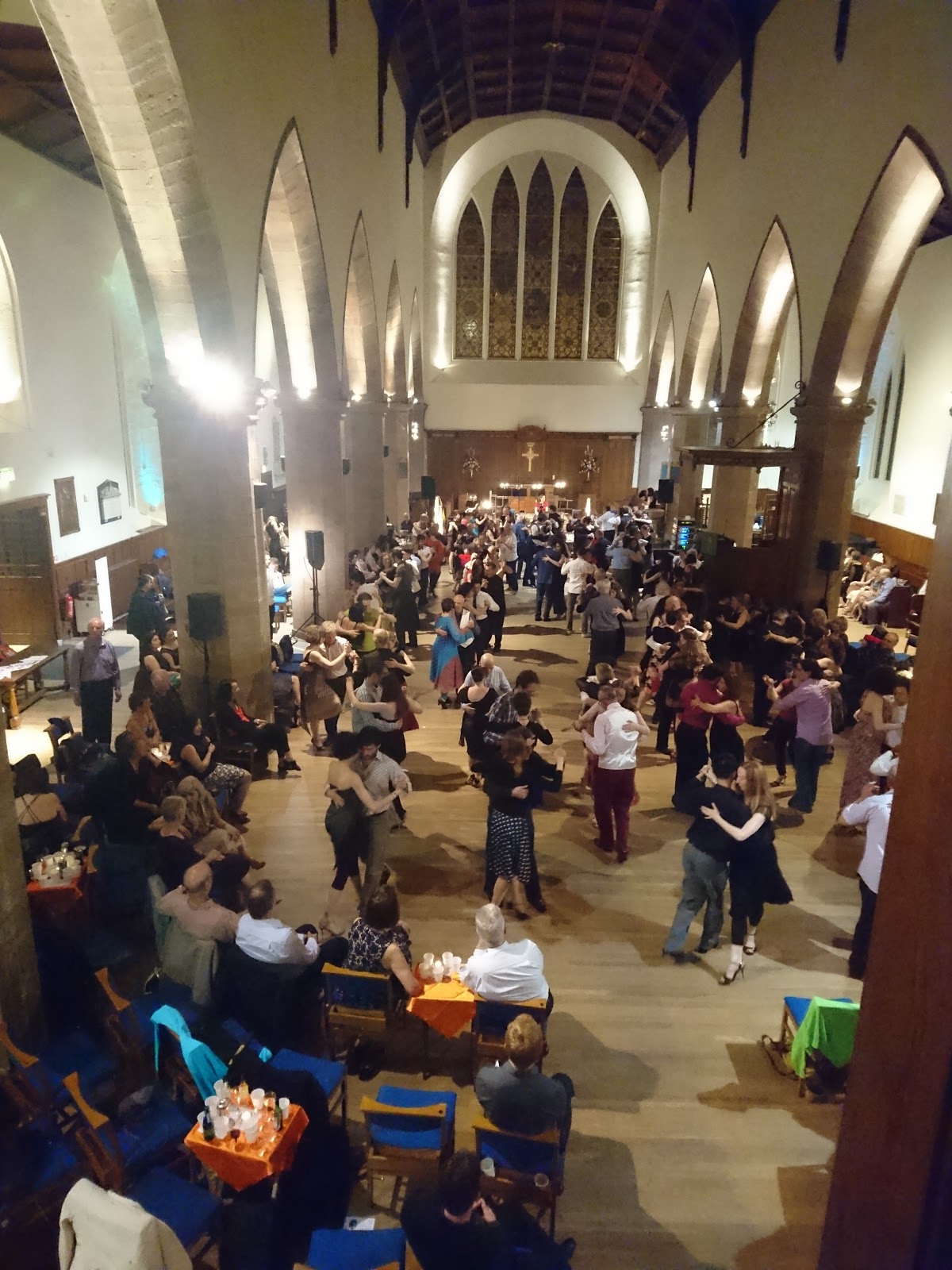
The ronda does not look too bad in the top photo, which was taken at about midnight but you can see the right hand side is not as well defined as the left.

The orchestra was great. I danced four tracks with a woman friend and enjoyed it. I would have danced more with others but felt you particularly need the right partner and better conditions for that strong music. I could feel it coursing through me. It was like being in, being part of the music as with the best recorded music only more so. At least two people who did the orchestra’s musicality workshop said it was the best part of the weekend for them. One who went said: a live orchestra for a dozen couples and his expression spoke his enjoyment. I half-wished I had attended but don’t think I could have borne any required partner rotation which is usually the risk in class.