Showing posts with label Edinburgh. Show all posts

Friday, 17 June 2016

Catharsis

A guy came to sit on a chair to my left. Like me he was visiting for a few days from I think Wroclaw. While we watched he cracked jokes. I had been feeling the strain the last couple of days, his humour was cathartic and I was grateful for the easy banter.  

He had seen my friend was new in the milongas.  In a stage whisper he said Ask your friend to ask that girl to dance with me. He indicated the girl to the right of my friend.  He leaned across me - Ask her for me he hissed again. I knew my friend was safe but looked at the visitor askance at this attempt to play a newbie joke and we all laughed.  He didn’t get the dance he was hoping for. You dance with me again! he said. 
No! I said in mock outrage. Besides, I will dance the rest of the tanda with my friend in a moment. 
Ah, he said feigning injury. What do you call it when a girl says you know, no, to a man? I gave him a “Don’t come that” look and was annoyed to feel my heartstrings tugged even though I knew he had contrived the situation and just for fun.  But I could not bring myself to tell him the word I was sure he knew.
I wouldn’t be a second choice anyway, I said, avoiding it.
Third, actually, he said evenly in his apparently artless English that I knew to be anything but without guile, yet the very brazenness was part of a game. I looked at him, predictably speechless at the affront yet knowing it was in jest.  He looked.  The tension sung in the air a moment then we broke down into laughter that continued quite a while. 
Eventually, he said: You will change, you will come back and dance with me.
Really? 
Ah yes, he said.  Women always do. I gave him another look between scepticism and pretence at being impressed.  At least, my last resort, I can tell myself this he said and again we laughed. 

I met a local girl in the Ladies. We both wore pink dresses.  She had long blonde hair that reminded me of another woman from Stuttgart with whom I had danced at the 2015 Edinburgh International Tango Festival, though that women had been as tall as me.  I had seen her in the regular milonga that week and though she had looked I had not been brave enough to invite her. At the festival she was sitting at the end of a row with no chairs at right angles and no bar or obvious place from which to invite anyone sitting there.  Because of the seating that year in the South side venue she was in a very difficult position for invitation. She did not appear to have danced much yet I knew she could dance. I wished now I had invited her in the milonga instead. The only way to invite was to prowl round and loiter by the entrance. I hated the idea that I would try to invite, she might refuse and in that exposed position I would suffer.  This was before I for the most part stopped moving from my seat to invite women because I feel that indiscretion too much.  I persuaded a guy friend to come and pretend to chat to me by the entrance and to tell me if she was looking.  Do guys do this?  Do guys suffer such anxiety for us? I wondered thinking the situation absurd but finding no other way.  She did look, we danced and she was a dream to dance with.  I have been wanting to dance with you she said to my relief.  I looked for her when I travelled but did not see her.

The girl with similarly long blonde hair wore a dress that was very pretty and I said so.  She returned the compliment.  She wore specs.  Later I saw her dancing and thought her beautiful, happy, slim and a good dancer. Later still, shortly before I left we fell into chat. She said she had been at Tango Loft on Friday then to a milonga in Darmstadt on the Saturday which she said was lovely. It turned out to be Sascha Weinberger’s milonga  though he was away that weekend. I have wanted to hear Sascha DJ for a long time along with other German DJs Thorsten Zoerner of the Dusseldorf TangoAtelier  and Christian Walker of Freiburg (does anyone know if he has a regular DJ slot?). Her weekend - Friday at Tango Loft, Saturday in Darmstadt, Sunday at El Amateur seemed like a good idea. Before I left she embraced me.  Because I had liked her straightaway I was only half-surprised at her warmth and openness.  I felt happy too.  With the relaxed chat that evening I started to feel myself again in the milongas and for the first time that weekend.  I was sorry it was just before leaving.

Friday, 10 June 2016

EITF: Monday


Monday night

I had stayed overnight in Edinburgh after the main festival milonga the previous night.

On the Monday afternoon and the evening milonga I stayed sitting for the most part with friends, none of whom, curiously, were from Edinburgh.  When they said they found the atmosphere closed I wondered if there was a connection between the two things.   I enjoyed the girl chat. For me that Monday afternoon and evening were the best part of the weekend largely for that reason. Sometimes we danced.

The DJ I was most keen to hear was Juan Venegas Ortiz. Juan used to live in Edinburgh but retains the ties.  I knew he could do good sets but sometimes I would hear the odd bit of drama and the occasional Guadia Vieja tanda and occasionally more than a bit of these. I was curious to see which way he was going.

The music was the best I heard this weekend.  I stayed in the salon and danced more so my music notes are more confused for that day. However, I can say  that of the two DJs I heard that day Juan is the DJ I would hear again, being the more mainstream.

As I recall there was great D'Arienzo, good Rodriguez including Este es tu tango and Por eso canto yo. The latter is OK and nice music but not among the best for dancing I think and I find that repeated "ding" on the piano a bit contrived.  I hear it as uncharacteristic of the orchestra, in fact come to think of it it doesn't sound at all like the pianist I expect in that orchestra.  Or maybe it is.  I guess if I'd been on the piano and made to record that track for dance I might have protested the same way.  He sounds a bit ironic to me.

There was a tanda by Laurenz.  I remember because I had two of my best dances of the weekend to that and the Rodriguez with a visitor from somewhere near the Midsummer Tango  event. A friend had previously told me about it. The visitor looked a quiet, even hesitant dancer, easily missed, but I suspected he did not feel that way.  Indeed, he was quiet, assured and musical which is how I and many girls seem to most like them. He disappeared off to class at one point and I could not fathom why he would think he needed to.

I think there were the irresistible Demare vals including No nos veremos más.  Unless I am mistaken there were the Troilo/Marino milongas I like including Barrio del tambor so I guess the others were Con mi perro and the seductive Con permiso but hard to dance without being unpleasantly jerky for the woman. I think these are the best of the possibilities though I suppose one might have been Cimarrón de ausencia. I have a feeling there was also a Troilo/Marino tango tanda of type e.g. Copas, Amigos y Besos  though I think the Biagi/Ortiz is better,  Sombras nada más (“show me that tango passion”- a great tango for performers) and Siga el corso. 

There might have been later Pugliese-Morán of type Pasional and Barro.

I recall dancing good Malerba and next to my note about that is that there was a there was a weird vals I couldn’t place and terrible OTV tangos.  I have heard ropey OTV from Juan before e.g. Viento Norte.  Boy, can you hear it’s 1929.

Not to do him a disservice one of the DJs this day played poor OTV tangos of type Justo el 31 so it might not have been Juan. No matter, whoever it was, this track does not fit in an otherwise largely mainstream set (which Juan’s was). I failed to find the track on the internet, for reasons that will become obvious so here it is on Spotify. I have met people who genuinely like this type of thing and I think all these sort of tracks should be saved up for that select group to enjoy at special milongas of just this sort of music because to inflict them on the rest of us is pure torture.  It isn't just me, see my friend's comment on the similar Lomuto below.  I believe there was also Viejo Arrabal which reminds me of a doolally elderly lady lost in dreams of girlhood. I cannot again find a link on the internet (hint: no one else likes it either) but here it is on Spotify.  Seguime corazón which in comparison has a lot more about it. I don’t know if it was this because I see different versions of it on the internet apparently by OTV though with different melodies but this struck me as easily the best of those.  Considering the rest of the tanda though I'm inclined to think it sounded more like this.  Even if it was the first version, OTV is not for everyone though I heard it played - especially the instrumentals (and not rarely) in various milongas in Buenos Aires.  There is a world of difference though between the (lots of) poor OTV and say Ventarrón.

Most of the rest of Juan’s set I enjoyed and there was a good mix. The dancers showed much appreciation at the end.

Monday Night


Monday night

The salon was prepared differently for the evening compared to the afternoons events. It looked nice but it was darker though this does not really come across in the photos.

The DJ was Jörg Haubner (Germany).  First I should say that once I plucked up the courage to ask him about some of the music which I did several times he was approachable, pleasant and patient.  When I asked him if a tanda later on in the evening was his second Canaro he looked at me as though amused and said yes but that his second one was with Famá from a different era. I had danced I guess the later Famá (which he played earlier) which included perhaps Al subir, al bajar - a mood changing track and one of the happiest I can imagine if you aren't snooty about Canaro and I have been surprised by the number of unpretentious guys I like who refreshingly are not.  At any rate I did not know to recognise all the tracks and asked if I could note the tanda which I had quite liked. He agreed, kindly and I wrote it down but unfortunately as I wrote it on a napkin it did not survive until I had time to reconcile my notes. The earlier one he played later was of type “special” Canaro e.g. Bernabé la fiera - El trapero - Ya vendrán tiempos mejores.  This would go well I feel with that type of OTV I mentioned above, or the Firpo or Lomuto which came later.

I arrived to great D’Arienzo or rhythmic Tanturi - I think it was great D'Arienzo to start and mostly good Tanturi later. There were very few people that early but I knew one lady and we danced it. It was one of my favourite tandas of the weekend because the music was great, I liked my partner and she could dance and with so few around I felt relaxed with no pressure.  Not too long after I danced milonga and later I think Biagi with my most regular guy partner in Scotland, swapping roles back and forth.  Because we know and feel at ease together I felt my normal self return. My eyes were red with sleeplesness but even so I knew after that I was going to dance more naturally than earlier in the festival.

There were De Angelis/Godoy vals which I hear less often but I think they are nice: Angélica (1961)
Hermana (1958)  - I do not think I have ever heard this - and Imaginación (1950).  I have a note that they were played early though and this felt a bit odd because they feel like tracks later in the evening, or maybe that is just in memory I think I heard this sort of thing in Berlin.

Other vals were the OTV of type e.g. La Serenata, Amor Eterna  which I hear little and Amor y Celos.

It was towards the second half of the night during the Canaro-Famá from the earlier period that I considered leaving. After that there was:

Pugliese Moran which was for sure a contrast, of type e.g. No me ecribas, Sin Palabras.

There were Lomuto vals Bajo el cielo azul and Rosas negras  which I don’t think I’ve ever heard but think is nice as with several Lomuto vals. He seems made for the genre. There was the more well known Un vals/Se fue.  

Then D’Arienzo/Valdez of type En el cielo and Por tu culpa te perdi.  Why I didn’t leave at this point I can’t remember.   It is possible it was fascination to see what came next.  I know none of us girls had danced much or at all in a while. 

In fact it was Firpo.  Firpo has become so unpopular among mainstream dancers that I have even seen an encuentro promising no Firpo - no Firpo as advertising, that's how unpopular it is among most good dancers. There was La Bordadora.   I looked at my friends. One gaped in disgust and disbelief saying What is this dirge.  I am afraid I laughed because that is exactly how I often describe this funereal music. I remember a long time BA resident saying in Lo de Celia, a traditional milonga in Buenos Aires, pretty much the same thing when a different (and much better) Lomuto track came on. You have to be careful though with Lomuto, a hair's breadth separates the good from the very bad and, as with OTV not everyone likes it.  And never play Firpo tangos.  Actually I heard the same thing said about Lomuto in another milonga there and by another ex-pat. In the majority they are used to different sorts of tracks.   After that was Firpo's La Carcajarda which I recognised from that cackle.  

Of visitors I did not know I danced with I think four guys during the EITF and one  ambidancing woman.  I wished I had been more relaxed for better dancing with girls before the Sunday night  but did find the conditions inclined me that way.  The best part of the festival for me was the girl chat, hearing the differences in music played by the different DJs and the opportunity to hear La Juan D'Arienzo. 

Tuesday, 7 June 2016

Edinburgh tango festival: Sunday, including La Juan D'Arienzo

Greyfriars kirk

I usually avoid live music and cover orchestras but this orchestra has a world class reputation and I bought a ticket in advance.  I had already heard recordings of their great instrumental tracks.  Initially I had intended to go to the EITF only for this orchestra.  Music and dancing in Edinburgh as it is means so far this year I had danced there just twice (at La Redonda).  

It was not, therefore for the local music and dancing but curiosity, the chance to dance with visitors, to see my visiting friends and to catch up with people I had not seen for a long time that persuaded me to go back to the Sunday afternoon cafe.  


Afternoon cafe
Someone outside said he had come for the milonga but that the class was still going on.  A class overrunning 45 minutes after the start? I queried.  He had been outside for fifteen or twenty minutes so perhaps not quite that long he said.

I chatted to the box office staff for a while and by the time I went in to the salon the milonga was underway.  The DJ was Antonella Cosi, head DJ at the Edinburgh Tango Society (ETS) and organiser of El Tango Club milongas.  I arrived to a cracking D’Arienzo tanda, type e.g. El cencerro, El caburé, Ataniche which immediately improved my expectant mood.

 Unlike the previous day I was wearing girl clothes and heels. People gave compliments for which I was grateful.  I was to need them later. 

Cortinas
Though the cortinas were longer than the previous afternoon during one of them I counted twenty on the floor. 

Forgive the diversion:  In the ETS regular milongas in the Counting House the confusing,  frustrating and absurd notion of the "silent cortina" used to be the norm until a year or two ago - the excuse being that it was less disruptive.  Less disruptive no doubt for those who want to stay on the floor - as if these are the only people who matter.  Tolerance of, in fact support for that habit remains and was apparent at the festival among some of the ETS head honchos, despite the extraordinary rules. Once started, the practice snowballed as it often does with such things.  It reminds me of feet on seats in railway carriages.  Some years back some rail companies, sensing much public distaste took a tougher line on that practice and it seems to me to have dropped off.

You see people not clearing the floor generally in ETS milongas and notably among those who are anti-cabeceo. The Counting House milongas were my nursery and it is because the floor at the time so seldom cleared that it was a year or two before I learnt the that the cortina is not only an opportunity to swap partners, but more importantly, it lets everyone see to invite by look so that all may have an opportunity to invite efficiently and discreetly, not merely those already on the floor and with no plans to leave.  Now those who remain on the floor usefully demonstrate their disrespect for others who, seated, are trying to see across it.  It is curious that those not clearing the floor included some of the ETS committee which apparently does exist though its members are still, as far as I know not elected or officially named. Even the student tango society holds elections. What with half the committee sticklers for rules and somewhat more traditional music and some quite clearly not, ETS looks under some strain these days. 


Dancing
I spotted about five guys I would have liked to dance with - four of them from out of Scotland.  I had had a good seat but was blocked by the odd couple in front and I did not want to move.  There were younger girls and good dancers in better positions.  I decided to call it quits before mid afternoon. 

Atmosphere
A complaint I heard more than once over the weekend was that the atmosphere was flat.  The same adjective was used by different people. Nonetheless, I heard that at least one of the evenings, I think it was the Saturday night sold out.

***

After I had changed my shoes I spotted my friends, popular dancers, arriving as I left. How had the Saturday night been? Their expressions registered dissatisfaction again. More hand-offering? No, just people who know each other dancing together and sticking together and not great dancing. Had the floor cleared in the cortina? No. That had been the other problem. 

A good milonga started and I danced it with a female friend in my chunky, sparkly pink flip flops - repeating almost exactly the same circumstances from three months previously when I had danced like that to amusement in La Viruta with a porteña I had met in the more traditional milongas. We had been about to leave when a great milonga started and she had asked to dance it.

I left more upbeat again. What’s wrong with me?  I half-thought at my inability to get the dancing I wanted. I wondered at the thoughts of the other women I had seen leaving or who would leave.    I had not realised at that point that the largest single influx of visiting dancers was probably from London, which explained much.  Twenty-five in number I heard from one of them, though they did not all arrive together.  There is a distinctive London style in the milongas because I can sometimes recognise such dancers when I see them on the outer side of the London orbital.  

As I walked along outside at the pavement cafes guys looked, caught my eye and held it.  I started to feel better.  A tall, good-looking guy standing on the pavement about to make a phone call grinned at me from behind his sun-glasses and complimented my pink shoes. I answered my own concern: Nothing, in real life! I thought, pleased. It only seems like it in the world of that milonga. I felt relieved I’d left and spent a tranquil couple of hours in the sun.

Curious to see how things had worked out I went back for the last hour and chatted with friends.   The atmosphere and conditions felt unstable. I did not feel like taking any chances and danced with women I knew though even then not well but also with one or two guy friends.  One gentle dancer always understands the conditions of the woman: "But it took me a long time to realise that" he said.  He said lovely things about my dance as though he realised I needed the boost.  I had been relaxed outside the milonga and still was, in the fun chat with my friends, but realised that inside the milonga I was not relaxed enough to dance as I wanted in the other role.  Besides, the music had deteriorated by the time it reached that last hour. 

***

Music
The volume was significantly better than the previous day.

I heard tracks that did not sound anything like D’Agostino then two D'Agostino, I think Así era el tango and Ahora no me conoces.  The mix of those two with something else was so odd I assumed it was an error.
Then there was:
  • great rhythmic instrumental Di Sarli of type e.g. Retirao, Catamarca, Shusheta
  • Demare songs with singer Horacio Quintana of type e.g. Torrente, Solamente ella, Corazón no le digas a nadie (nice, but not the best for dancing for me), Igual que un bandoneon.
  • Canaro vals of type e.g Sueño de muñeca, En voz baja, Ronda del querer  
  • Great Troilo with singer Fiorentino of type e.g. Total pa' qué sirvo, Toda mi vida, Tinta roja, Cachirulo
  • Infallible Caló songs with singer Raúl Berón, of type e. g. Jamas Retornaras, Corazon no le hagos caso, Trasnochando, 

I remember less clearly the music in the last hour although there was Canaro, possibly with Melodia Oriental. I don’t think it was the Zerillo version. There was a dire tanda, very poor Lomuto I think, typical of what I remember from the ETS regular milongas type e.g. Cuando llora la milonga  I want to say there was Violin Gitano but I can hardly believe it could be that bad and yet I know it can.  I am pretty sure there was Quiero verte una vez más probably in the Lomuto tanda though it might have been the Canaro, I forget. Both are nice for me.

Sunday night
The main milonga of the weekend was in Greyfriars Kirk, situated within the tranquil setting of its kirkyard.


The DJ was Ewa Zbrzeska with performance from the live orchestra.

Sound from the DJd part of the night was extremely loud and inescapable from speakers all round the floor. I had heard poor reports about this DJ and would be unlikely to attend a milonga with her DJing again. Much of the music was very “tango passion”, not what I enjoy. As an example I believe there was De Angelis/Larocca of type Volvamos a empezar  and Como nos cambia la vida and early on at that, or something similar which felt even more odd at that time. I think I heard Troilo-Marino too or much in that vein.

In the past the Greyfriars' floor had been notoriously slippy but was about perfect now. 

Seating and lighting was quite good. You cannot see everyone for invitation because of the size of the venue but guys could move around to invite from different spots without too much bunching and loss of discretion.

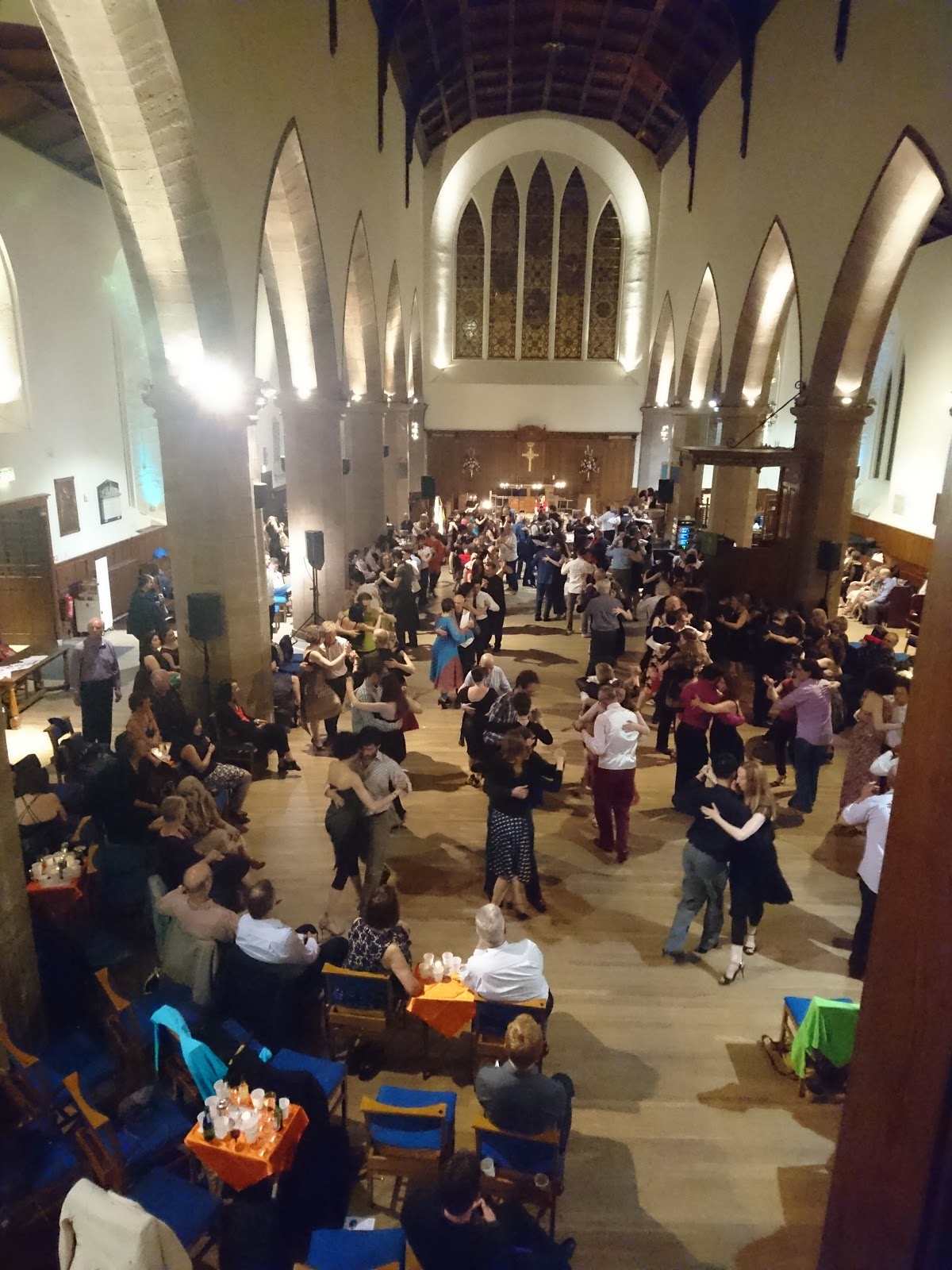
The ronda does not look too bad in the top photo, which was taken at about midnight but you can see the right hand side is not as well defined as the left.

The orchestra was great. I danced four tracks with a woman friend and enjoyed it. I would have danced more with others but felt you particularly need the right partner and better conditions for that strong music. I could feel it coursing through me. It was like being in, being part of the music as with the best recorded music only more so. At least two people who did the orchestra’s musicality workshop said it was the best part of the weekend for them. One who went said: a live orchestra for a dozen couples and his expression spoke his enjoyment. I half-wished I had attended but don’t think I could have borne any required partner rotation which is usually the risk in class.

EITF: Music, Saturday afternoon

The DJ was Mike Quickfall, The 2.5 hours I heard of the set was quite good. The tracks were great and good tandas but rather unbalanced.  I was surprised how many good tracks because while I had heard a good set by this DJ when he first started, the next set or two that I heard was or were so alternative or had had just poor music (therefore not what I call traditional, even if it is old) and not what I liked that I did not go again. 

Tangos were in four, vals and milonga in threes, cortinas were pretty short, ~10s. I did not keep track of it all as I danced some but what I heard was roughly like this:
  • Good trad vals on arrival. Later on there was an alternative vals.
  • OTV - Anoche a las cuatro - Mi taza de cafe - Una vez
  • Another Mi taza de cafe, in the next tanda: Malerba. I have heard this DJ repeat tracks and also orchestras before in sets to the detriment of balance. There was another good track or two, my sense was that it was Malerba and José García mixed but I was chatting. I think I heard Qué no sepan las estrellas by García. If I’ve got that right it was a bit of an odd mix. Despite that Malerba is very distinctive it didn’t jar badly with me - but might have if I’d been dancing. 
  • Great rhythmic Laurenz including No me extraña and Amurado and I think De Puro Guapo but again I was chatting. 
  • There was vals Lagrimas y sonrisas, Biagi I think, then something I didn’t know then Corazón de artista, Malerba but I thought it worked OK at the time. Who would think this vals could be so different from his serious, ponderous, tangos?
  • There was great Fresedo, good D’Arienzo with I think El flete about here, good milonga, good rhythmic Lomuto songs, good Donato songs. Then there was nice Rodriguez and I heard a Biagi tanda which I’d seen on the playlist and knew to be great with e.g. La maleva and friends. It was not necessarily in that order.
What I heard then this time was quite an earthy set with OTV, Donato, Rodriguez, Lomuto.   To break up the earthy tandas it would have been nice to have something smoother and more sophisticated - Caló, D’Agostino, De Angelis.  Perhaps a Troilo or Tanturi for a different sort of rhythmic sound - to break up the rhythmic tandas I had already heard. Someone who listens, who stayed later than me and hasn't much time for the earthier music said that later there were missed cortinas and that as well as the two Donato tangos I heard there was also a Donato milonga…

The good music I heard was largely ruined by the volume. The speakers were at one end. Even opposite these by the entrance and DJ spot it was far too loud, sometimes deafening. I have also heard very variable sound from this DJ before at the Counting House - too quiet and too loud, usually dependent on whether he was dancing or not. Once that afternoon during a cortina when I was - madly - for a short time sitting near the speakers chatting, I felt the sound go inside my body and and felt it reverberate right through me more than I actually heard anything. Luckily i had blocked my ears and moved straightaway. Later in the weekend I saw an experienced dancer wearing earplugs and thought her wise.

Edinburgh International Tango Festival: Saturday afternoon cafe and generally


My husband ran a finger below my eye. You look tired he said. I’ve never seen you with that before. Oh! I said, and looked in the mirror. I had slept little and it was true I had lines under my eyes. We're getting old he said laughing. And what the hell I thought as I went out to do messages in town before driving the hour to Edinburgh. The following week a mum in the playground said that when she told her husband she felt unwell he’d said “You’re getting old”. I laughed at her mock outrage in the retelling and at the coincidence. At least yours said “we” she said. I didn’t tell her my husband’s several years older than I. 

Entrance
This year six of the seven milongas for the EITF were in the same room. The venue was the Teviot building, part of Edinburgh University. You pay £4 entry for the cafe downstairs to the friendly volunteers. I knew one of them and was warmly welcomed. This year on the same level as the salon there is a cloakroom and chairs to change shoes. If it existed in previous years I had not noticed it. 

Refreshments
There were no water jugs or they were empty outside the salon. I went on a hike to find some through the warren-like building to the cafe a couple of levels back down. I came across the organiser there and mentioned it to him. Over the event sometimes there was water, sometimes not. During at least two of the other milongas in that venue I saw no table, jugs or cups for water. There are bars in that venue but the two I went to were closed. No one was drinking anyway. You couldn’t really risk it (see seating). With water unreliable or non existent people eventually got wise to bringing water bottles in with them.

In contrast I liked the tango cafe last year at Bailongo. There you could get decent food and drinks in the room itself.  I remember salad and cake. It was nice and contributed I felt to the relaxed atmosphere.  Two years ago at Bailongo the cafe conditions had been diastrous: the (differently managed) cafe area was right next to the dance floor which was sticky anyway, the space too small, no gangway, lighting too bright, everything had been wrong. But last year the room had changed and everything was much better. I liked the light and airy EITF tango cafe in the other Student Union building last year too though the seating had left a lot to be desired.

Rules
The tabletops had been made into diagrams of floorcraft. Distributed among these was also the most comprehensive list of rules I have ever seen. It was a pamphlet actually including another copy of the same floorcraft diagram. There were nearly fifty items to consider.  


The previous night
Before getting changed I looked in to the salon and spotted some women I knew who were visiting. How had it been last night? They looked uncomfortable at the memory. One looked positively unhappy. Guys had walked up to invite, even hand-offering one of the women said with an understandable shudder. I guessed such guys had not read/cared about the rules. But then I think things change successfully for reasons other than rules.  I said that with any luck it would be better this afternoon with more of that sort in workshops. In the evenings there is a bigger mix of incompatible people including workshoppers with less experience of milonga etiquette. Apparently the Friday night opening milonga had been busy and the ronda rough.

If I go to festivals - and I have tended not to, for all these reasons and more - I prefer the afternoon dancing for exactly this reason. The lighting tends to be better too.

Attendance and dancing
It was quiet when I arrived.  Fourteen people on the floor, one life couple who were good dancers I had seen before and a number sitting. There were mixed ages, mixed ability. There were some good dancers, many but by no means all of these younger. It got busier over the next hour and at some points it was really busy. 

The ronda at the EITF was one of the worst I can remember since...probably the last EITF. It is not bad at all in the single snap I took of this day as I was leaving but it deteriorated. It can be I think a problem with festivals where a crowd of people who don’t know each other get together, many of whom prioritise class moves over social dancing. So actually all those tabletop diagrams and rules shout that this festival is full of people who need this sort of telling.  But the truth is they are unlikely to pay it any attention because from what I saw, fundamentally the festival-going type do not care about the niceties of social dancing. Some guys do, I know and some, being class-dependent or just,  like me, miss years of experience in the ronda. But the ronda deteriorated over the three days I was there. Once during Sunday night the guy in front of me changed three times, though actually more than that because those three guys kept lane swapping between each other too. I remember once being between two good ronda dancers, which is to say they just kept their place, and thinking what joy, what peace, what uncommon bliss. I saw Edinburgh and ex-Edinburgh dancers with years of experience, who can get good girl dancers but who simply cared not one jot where they were or what they did in the ronda.  Such arrogance is a very Edinburgh attitude among that guard. Combine that with a large influx of London dancers, the more random elements of the Glasgow and Aberdeen crowds and a sprinkling of visitors and you have the perfect storm ronda-wise. On the last day I was so frustrated I felt like raising both elbows and attaching scythes to them, at which point I considered it might be wise to quit dancing. 

Conditions
Lighting was OK though it was bright spots, - theatre lights I think. By the Monday certainly the lighting had changed to this (apologies for the photo quality) which was darker but softer and less blinding.  In the upper left and right sides you can see the lights they had used, now turned off.


The floor was good. The room itself is attractive. Room size and shape were OK but quite large. 

Seating: chairs, tables, access
There were chairs and some tables though more on one side. The small tables made people feel quite connected I think. Big tables in contrast split people into groups. If you are in family or friend groups which some (usually less central) milongas particularly cater for in Buenos Aires then you might expect large tables. But in the UK big tables often force together people who would not necessarily sit together and separate them from others. At the EITF the tables are the small and lightweight folding kind. They are a good size but too light and in those floor conditions were knocked easily and often. That is why you could not risk putting e.g. a large bottle on them. In Buenos Aires I found the small tables more robust.

Apart from the floor not clearing in the cortina the biggest problem was the lack of gangway round the room. People walked between e.g. two dancing couples at the start of tracks and on the floor during tracks. Not just couples but groups stood on the floor in the ronda to chat at the beginning of or between tracks. Both issues worsened during the afternoon and during the festival. The worst spot for arriving pedestrians paying no heed to dancing couples was at the entrance. One pedestrian bashed into my partner and I as we danced with nary an acknowledgement in her haste to reach her seat. 

Invitation
... was difficult because chairs were straight on to the floor. Being so close to the dancers, post-cortina after the first 10 seconds you had no chance to see. This happens in Buenos Aires too but I found you generally have more view of the room than in the Teviot salon because there can be more depth behind the seated dancers. Also at milongas with separate seating the seating is specifically arranged so that you can see guys often to your left and/or right and/or in front e.g. El Beso, Obelisco, Consagradas at Salon Leonesa, Salon Canning, Lo de Celia. Also, guys can and do often move around the room to be closer to invite if they are far away and /or the dancing has started. 

But because in Teviot there was no gangway it was nigh on impossible to move somewhere else if you had no luck inviting at first - unless you walked on the floor and upset the ronda along with everyone else doing the same. 

As the floor increasingly did not clear in the cortina it was even harder for people seated to see to invite. Sitting by the door to the left was a bad idea because the guys standing in the entrance meant your only chance was them or to try to seek invitation down a row (LHS of the photo) which is always problematic. The area to the right of the door was taken up by the DJ and ETS stalwarts. A corner at the far end was taken by other ETS experienced dancers. Everyone else fitted in where they could. I noticed visiting couples dancing often with one another and many visiting women not dancing and looking glum, though others did. The same was true, though less so for some visiting guys.

To get round the "I can't see" problem, many people, guys and girls but especially guys seat-hopped to try and get a view of girls so people never knew where to find each other and seats/tables got taken. Again, if you like a calm environment, it was not that. 

Atmosphere
I am not sure. I don’t know how many cared about the conditions but there was a lot of movement in and out of the milonga though whether to classes or because people weren’t enjoying it I am not sure. Either more people are wise to poor conditions or I am more aware of them but I had a sense some people were not sticking around because of the conditions or were not getting dances. And some were. And some were having a good time. 

I danced in flats with two local friends soon after arrival and two women visitors I had danced with before. I did not want to take chances with my knee with guys in those conditions. I found it chaotic, frustrating and noisy and left at 1630 after two and a half hours with much relief.

I had skipped lunch and went for good soup in the relative calm of Peters Yard five minutes away by the Meadows. Then I drove home yawning and with no desire whatsoever to return for the evening milonga when I suspected the conditions which had curtailed my visit would be exacerbated. I am much more of a local milonga girl - where those are good. Local milongas have had longer to get the music and conditions right,and these tend to attract the kind of dancers I like.

Monday, 25 April 2016

La Redonda milonga and Edinburgh


La Redonda, Edinburgh


On Thursday I went La Redonda the milonga in Edinburgh that’s been going for a few months. It was the only milonga I’d been to since getting back from Buenos Aires in mid-March. There is an imaginary parallelogram that describes the area with milongas in central Scotland. Its points reach between Edinburgh, Glasgow, St Andrews and Forfar (Padanaram village has the dancing).  Besides these there is some dancing in Stirling, also at Stirling university in the village of Bridge of Allan and some dancing run by a couple who teach in the town of Dunfermline and the nearby village of Dalmeny. Within this area, La Redonda is the regular milonga most attractive to me just now.

It is an easy decision because in the first instance I go where I think I will find tandas that are not in the majority, broken.  Other conditions are a good floor and a host that is at least not off-putting and these thankfully are rare.

I went to La Redonda once before, in mid-February with a Spanish friend, a guy brand new to dancing tango. One of the nicest things for me was the warm welcome. Ricardo, who co-hosted with Jenny also came out to say goodbye when we were leaving. It was the best milonga I've been to locally since Ksenija's one-off milonga before Christmas. The atmosphere was relaxed, people seemed tolerant of my friend and I in our swapped roles. The atmosphere contributes in no small part to new dancers feeling at ease, even more so when it is a guy dancing in the traditional woman’s role. People there said they liked the atmosphere. 

Music
The DJ both times I went was Claudia Esslinger though she does not DJ every time. The music was great. The first time there was even good Fresedo - as opposed to Fresedo that is too early or too late. I heard the kind of OTV I don’t like as I was changing my shoes with only one good track. I apologised to my partner and we sat down once during I think a Tanturi-Castillo for possibly the third track because it would have been worse to try to get through it than to not dance it. Not only is Claudia one of the most experienced DJs in Edinburgh, if not the most experienced, she is far from being a “me-jay”. I am sorry she is apparently not DJing at the Edinburgh Tango Festival. 

Floor
The floor I found good the first time. But last week I stepped on to it in flats with a friend and immediately felt my shoe gripping the floor. With a knee problem simmering away I could not risk pivoting. The floor is old though smooth. Someone said it had been mopped just prior to dancing so perhaps that explained how I found the difference. 


Ronda and dancing
I am delighted that La Redonda is class-free and indeed the milonga attracted a mix of people. In February there were about 40 including several from Glasgow. I think the idea is to attract a broader mix than had been the case at these hosts’ practica which had been on the same day as their main class night and had attracted mostly those doing the classes. On Thursday it was also busy, with a couple of solo experienced dancers who it is a pleasure to watch. The picture was taken later on in evening of my first visit when numbers had thinned.

The first time there was a proper ronda with couple after couple in harmony but otherwise it was a bit chaotic. This was partly from some experienced dancers who don’t recognise a ronda. This is a moden then for new dancers.  There was a new guy who didn't move for ages, absorbed I think in a "tango moment" but oblivious to the pile-up behind him.  A new guy overtook me and then came back towards me, passing me. It was like realising you have a car coming towards you in the wrong lane on a road.  Sometimes people do such amazing things in the ronda that leaves you breathless.  Two nights later in St Andrews a new dancer cut through an inner and outer ronda, drawing the diameter of the circle like some random meteorite crashing through earth's orbit.  

Generally, the ronda could be tricky, all in quite a tight space. The second time it was much better. All the tall people moved into the centre. I was tired though, didn’t dance much and did not feel I contributed to good ronda dancing.  I had hardly danced in the guiding role for a couple of months, did not feel the connection with others in the ronda that I find in places with many experienced dancers but as yet this milonga does not have that kind of dancer in the majority. Since I rarely dance in Edinburgh now it was nice to see and chat to people I hadn’t seen in some cases since last year.

The first time I went to this milonga, mid-way through there was a "dance with a stranger" announcement which I have seen turn into a license for people to walk up and ask you to dance. Last time I dived for the kitchen so I was relieved there was no such announcement the next time. 

Venue, room, lighting, seating, snacks
There was a rack for coats outside. There was only one chair upstairs on a landing to change shoes outside the room. You might want to arrive completely ready as there is only one ladies room I know of.

The room was nice with an attractive barrel shaped ceiling.  It is often difficult to get good lighting in a hall in the evening. The first time I found the lighting just about OK. Jenny told me they had tested various lighting arrangements beforehand. The room had wall-based uplighters quite high. Jenny said they had a nice glow but when they tested them before launching the milonga they were blinding because of too much bulb. She said the overhead lights were nice and started off warm but got very bright.  They made therefore an ingenious solution which hasn't come out well in the photos but they are fairy lights: many many meters wrapped around a rectangular frame of metal and plastic. These they hung from the wooden roof supports with bungee cords.  The effect was rectangles of twinkly light. Last week although I think the lighting was the same it felt dark and someone commented to that effect.  Both I and a friend thought a woman opposite, in silhouette because of the lighting wanted to dance with us but we couldn't be sure and so nothing came of it.  

The tables were great. Although they are light and easily knocked they are small and ideal for milongas. In this respect they are like the ones you find in many central milongas in Buenos Aires. I have seen them more and more at Edinburgh one-off events. Note also how smaller tables tend not to get cluttered as in the picture here.  They create less of a sense of barrier than larger tables. Apparently La Redonda had started with larger tables and changed. There was no solo seating per se. There is the usual UK problem of new arrivals taking a seat you may have been sitting in for a while.

Snacks were in the kitchen along with tea, coffee etc. The first time there was some good cake, tangerines, chocolate later on. 

This is the best milonga in Edinburgh just now because of music and atmosphere. It is interesting that many of the habitués of Edinburgh’s other main milongas at the 'Counting House' were not present. 

Edinburgh however will never be a weekend destination to dance tango for those from other places while it has no regular Friday night, Saturday night or Sunday afternoon milonga. The Edinburgh Tango Society has long had a vice-like grip on the milongas that are run in Edinburgh. This has intensified under its current custodians who hold pretty much the monopoly on all the regular weekly and monthly dances. Edinburgh isn’t alone in being a city with a similar tango cartel. This causes fear in others who are quite simply afraid to start something new because of opposition and alienation from those controlling this scene at present. This situation looks set to continue.

Advertising the DJ

Last year on the day the Edinburgh International Tango Festival started I asked who the cafe DJs were as they were not advertised.  Shortly afterwards they were advertised on the EITF site. This year with a month to go the festival DJs are still not advertised. The first time I wondered if it was an oversight, if a serious one. Now I'm inclined to think it's perhaps if not policy then simply that the organisers just don't think that the music is all that important. 

It says here from here only “Each evening will feature an international DJ and a dance performance from our world-class maestros”. This non-advertisement of the DJs is astonishing because the DJ line-up at any festival that attracts good social dancers is a prominent, probably the most prominent feature of a festival.  But then many good social dancers tend to avoid festivals where the home page features show dancers preferring events that seem to be more obviously about embrace and connection. E.g. Encuentro Porteño.  I heard over a month ago who the DJs will be at the EITF from a friend who enquired and was disappointed when local DJ Claudia Esslinger (who DJd here recently) was not one of them. But so far the message is: this festival is for people for whom the music isn’t really the main thing, for whom the music isn’t really important enough that you’d much care who the DJs are. No surprise though when it was only after public request (now hidden/deleted) last year to the Edinburgh Tango Society that the rotating DJs were at last advertised on their calendar.

On the other hand, the EITF is hosting the orchestra La Juan D’Arienzo, which is great news. So this mismatch between not advertising the DJs and this great orchestra feels like a right hand/left hand situation.

Friday, 22 January 2016

Edinburgh (good news?!)


I mentioned here the lack of diversity in milongas in Edinburgh's long-established tango dance scene.   The clip above arrived in my inbox this evening.  It is about a new milonga in Edinburgh.

I don't know this venue but there are pictures of two halls here.

Jenny and Ricardo Oria are the most well-known tango dance teachers in Scotland.  I know them because for while I went to their classes.  They are not responsible for my change of views about how to learn to dance tango.  While it is true my experiences generally in classes did inform my views, those opinions about teaching dance versus learning to dance in a more traditional, less commercial way are not related to specific teachers with whom I took classes.  They are more to do with more general views about learning to dance, learning languages, a preference towards real social learning and an impulse towards choice, freedom and independence.

I did classes with some teachers in another town for six months or so but one day I danced with another woman, to kill (a lot of) time waiting for a man to become free in class.  I was soundly reprimanded for that so although it entailed much further travel I moved to Jenny and Ricardo's classes in Edinburgh where things were more relaxed. I was there (dancing in the woman's role) during 2013 but less and less through the year as increasingly, I danced socially locally and further afield.  

As a couple they have a sense of fun and complement one another well.  In the days when I tried to avoid social dance events with performances less than now I thought they suited the low-key, languid, elegant movements they sometimes chose.  I was starting to be interested in the music before I met them but Ricardo played so many classic tracks from the Golden Age that it was probably when I was with them that I started to pay attention to the music in a way I hadn't with the previous teachers who played tracks more repetitively.  

They are for me among the best milonga hosts I know in the UK.  They are welcoming, attentive to their guests, but not overpowering - and you do feel like a guest more than a client.  They take care, socially, of new people in their milongas.  There is always water made pretty and refreshing with cucumber and mint or strawberries and snacks.  They come round with chocolate later in the evening.  There always seems to be a lot of people willing to help.  

Bailongo apart - their milongas have been the approximately quarterly weekend events of workshops and milongas in Edinburgh called Nortena.  I haven't been for a while partly because since a lot of the attendees were class dancers more than they were milonga dancers the floorcraft, especially when busy in a milonga space which was quite intimate could be a bit haphazard for those conditions.  Another reason I haven't been to Nortena lately is because I don't always like the music. The early Fresedo in the video clip below (Felicia, 1927) is a good example.  It is not all like that.  When I was newer though I really enjoyed Nortena.

No problem for me with new people dancing in milongas if they stick in line and respect each other's spaces. In fact, there is no better way to learn to dance socially than to try it for real.   I've heard that the Orias' teaching style has changed a bit.  In 2014 I went a few times to learn to dance the guy's part but found when there were insufficient women the guys just expected me to dance the woman’s role. I wasn't ballsy enough to stand my ground then and left to just start walking in the other role in the milongas instead, a choice which has worked out well for me dance-wise and saved me a lot in petrol and classes.  Since then I hear things have changed.  I also hear more is said in class these days about the conditions in real milongas though I recall this was never absent.  With luck this will translate to good conditions in the ronda.    

This new milonga will I hope bring new people in to see what real social dancing looks like where there is much to learn just by watching and listening and to dance with regular social dancers who, like me have also been feeling that lack of diversity in milongas.  I say regular like me though lately, between poor conditions for dancing and unreliable music, I have not been that much of a regular in Scotland.

I have every hope this new milonga will be nicely set up and have a good floor.  Certainly,  Nortena was nicely organised [picture] with tables, cloths and from what I can remember, suitable lighting. Video here.  With warm hosts, sufficient seating, adequate lighting, dancing in the ronda and I hope great, classic tandas that will make new dancers fall in love with the music as I did then this milonga sounds promising.

Monday, 11 January 2016

Firpo (and Edinburgh)

In the summer I heard Organito del suburbio (Firpo, 1929) played by an experienced dancer, one of the current DJ crew in the rather shadowy Edinburgh Tango Society. Perhaps they exist but I have never seen a committee, accounts, public meeting or any kind of public accountability of this organisation to its - what, members, dancers, attendees?  In contrast to this apparently loose arrangement, milongas in Edinburgh are tightly controlled.  There is astonishingly little diversity in milongas for a scene with the longevity of that city - some twenty years.  The organisers at the Edinburgh Tango Society currently have the monopoly of the two regular weekly as well as the one monthly milonga in the city.

Organito del suburbio is the sort of track that makes me lose the will to live. You would have to be made of steel to be willing to travel to endure this sort of music which has been part of the Edinburgh milonga culture for many years.   It was teamed with Marejada (1929), example again by DJ Xenia of Israel and Entre tangos y champagne (1928) to which unless you're a masochist I suggest you don't listen. This sort of thing is why Firpo has such a bad name among many DJs. 

Whereas Fresedo, Canaro, OTV, Lomuto, Di Sarli all improve in the 30s, Firpo and De Caro do not, or not enough.  For a while, hearing it so often I thought I must be mistaken in my gut feeling about Firpo.  I searched once for hours looking for a decent track. Last week, someone else told me they did the same recently, with the same result. I even followed a social media thread about Firpo looking for a good tanda for dancing, without success.  At best there was Volver a vernos with Ignacio Murillo (1943).  Perhaps I've just been listening to Firpo too much again lately but it is pretty good and apart from a certain plod, a certain jerkiness, a certain affectation and a slight desperation in the singer, it hardly sounds like Firpo to me...  Di Sarli's (1942) version though with Podestá is better.  Arrepentido is too self important and heavy and if I cringed at the start by the last 35 seconds I don't know if I want to laugh, cry or am just transfixed.  It's trying stuff but it might fit well with the sorts of tracks (like Desengañao) prized by those who like "special" music. 

Fantasmas is - optimistically - a fun gimmick (not for dancing). I heard it also in a milonga in Edinburgh last year with El compinche (1937) and De vuelta al pago (1940) which I think is supposed to be clever and quirky and subtle as many Firpo tracks try to be and it is none of these.  Todotango cites La chola (1941) from this "inspired composer" but I find it in the same vein as these (no link available online).  Apparently De Pura Cepa was an early hit of his, and this might be it in 1934. But compare what D'Arienzo does with the track of the same name, as a milonga in 1935.  There's no comparison.  Why play Firpo? 

Milonga.co.uk calls his El amanecer ("the dawn") iconic.  According to tango.info, Firpo seems to have recorded this track many times. The 1928 version is a pretty awful, but inventive track. The 1936 version is manic and it isn't good for dancing.  The 1938 version is startling.  Everything is toned down, subtler, much more relaxed with the birds very much in evidence.  I still don't think it's good for dancing but it doesn't sound like most Firpo.  By 1953 he has gone back to the manic, stressed tone. By this time, Di Sarli had picked it up in 1942 and refined it in the well known version of 1954. I hear both in the milongas. Why play Firpo?

La murra is typical of the Firpo I hear from time to time. The jaunty tone tries to persuade you it isn't actually as dull and nagging as toothache. This and the moaning struggle of the tuba-like instrument makes me groan in unison. It's the kind of track you might nod off to only to be jerked awake by those insistent violins and that's before you get to the cheering and the chanting.  It was joined when I heard it in Edinburgh with Loco lindo (1936) and Vea Vea (1937) which both seem to try so hard, as often with Firpo and yet they just don't do very well. It is one of the things that makes listening to Firpo depressing. I prefer anyway the very early and wholly different Di Sarli version of Vea Vea - and even then not for dancing.

Firpo's Didí (1937) is embarassing, like bad Fresedo, especially in comparison to the Biagi version or the Tanturi. I've seen it teamed with Tierra negra (1947), which feels like a stand-in trying desperately to temporarily entertain an audience who've been let down by some other act.  You can hear examples of whole Firpo tandas by DJs Bärbel Rücker and Paul Svirin on Tanda of the Week here. Just compare though Paul's opening choice No quiero verte llorar with the Fresedo version and feel the qualitative difference. Why play Firpo?

Not far from me I heard in a social dance many tracks in the style of the Buenos Aires Tango Trio’s El Ultimo Cafe (hearing is believing).  Hearing afterwards Firpo's La carcajada (1935) I thought with relief “At last - a potentially danceable track”.  This though was in, I can’t say a set, because it had no discernible structure let alone cortinas but was stranded in a list of tracks so unremittingly undanceable that the reason I stayed was partly through a kind of hypnotised disbelief and partly because my children were happily playing and eating tapas.  Listening to it in more balanced circumstances I was wrong about that track. Leaving aside that insane cackle in the violins and the baleful tone of the piece, of course it isn’t danceable. When you consider what might otherwise be played who would want to dance it? 

I prefer Firpo in vals. In Aberdeen last year I heard Atardecer campero, Barreras de amor (both 1936) and Entre los ceibos (1942). They aren't my favourite kind of vals but I think these are nice, certainly in comparison to the tangos. I don't know if they pull me from my seat but I doubt I would avoid dancing them with the right partner. 

Poor Firpo. He was just too early.  He records Alma de bohemio in 1927 but the Biagi (1939) and especially the Laurenz (1943) versions relegate his version to history.  He records Ya no cantas, Chingolo in 1928 but is eclipsed by Rodriguez in 1943.  Because he has a place in the history of tango music is not reason enough to play him for dancing in milongas today.  When people come out to play, why would you lecture them?  Never to a partner and not via the music either.  Nor, for that matter by organisers to the dancers in general. There is a milonga in Edinburgh "borderline pretentious, so everyone is a little bit serious and constrained" (not my description) where people are lectured collectively, publicly about cabeceo and the ronda - "Everyone always sits squirming in the seats like naughty children."

Even in the 40s Firpo just can't quite keep up.  Here's Sábado inglés (1940), irritatingly Firpo-like, though so different to Volver a vernos and the relaxed 1938 El amanecer.  Compare though D'Arienzo's version (1946). And so it goes on. The desperate edge to La murra in 1936 and earlier is explicit in his frenetic El entrerriano.   But compare the great D'Arienzo version. (1946)  Why play Firpo?  Firpo seems to have a divided personality, sometimes plodding, sometimes raving, occasionally relaxed, when he is at his best.  His tangos have range, but it isn't good range, like Canaro's or Di Sarli's.

Unless the tangos really speak to you, please consider not dancing them because when you do it tells the DJ and their friends to play more of it and then you get whole geographical areas of Firpo, like a fungal blight, played regularly.   The awful thing is, if you hear enough of it you can get used to it as you slump in your chair.  Few DJs though really rate Firpo. When you ask them they do a sort of half shrug and look a bit shame faced and confess to a tanda now and then.  Firpo is one of their last choices, or their first - they put it on at the start of a milonga when no-one's there, with all the other poor early stuff.   Luis Petrucelli by the way is another such e.g Yo soy la milonguera, La Viruta (both 1928), heard in Stirling 2015.  Michelú (1930 - no online links but you didn't miss out;) is another, heard with La Viruta again in Edinburgh.  So is Julio Pollero e.g. Yo soy la milonguera (1928), Qué Vachaché (1928) also heard in Edinburgh 2015.  Playing these and the unmentionables to whom I gave enough space last time ensures virtually no-one turns up for the first hour of a milonga as is indeed the case at the Edinburgh weekly milongas. 


Not enough milongas are even the four hours that Edinburgh's used to be. Doubtless the idea is to try to bump up attendance when there is little throughput from class into the milonga from the 11+ teachers running classes locally. 

This is such a shame when Edinburgh in the last year or so had started to play cortinas in the milonga more than before when there was often its trademark "silent cortinas" with the many attendant problems those create. The lights will also dim for the milonga which I know from experience makes it harder to invite by look, especially for visitors. 

Were there great music played from the start, as elsewhere with good conditions such as excellent lighting and cortinas, people I have found are often in situ early.