A: I danced with a lovely dancer but he kept hold of my hands between tracks and conversation was personal questions not the music etc.
B: Single girls rarely allow that in a BA milonga
A: I know that! I'm just obviously very bad at or out of practice (or both) at extricating myself when guys don't play by the rules.
B: Rules??? :) You're a long way from classes :)
A: I'm sorry but it's wrong for a guy to do that.
B: I don't doubt it. But that's different.
A: It's not just wrong, it's wrong and in public where everyone can see. A respectable guy doesn't do it.
B: Very few Argentine guys are respectable.
A: Why make it the girl's job not to allow it?
B: Because he's not respectable! :)
A: God I'm an idiot. It's not that I don't understand it, I find the exercise of it so difficult. I don't know why. I should be cross. But I am cross. When he's hanging on to my hands I feel half rabbit in the headlights & half just terribly uncomfortable. Something in me wants to save him, us - me, actually - face yet while I may just be trying to pretend it's all fine really, my tolerating it means I lose face publicly with every second.
In any case, possibly disreputable guys can be very nice to dance with I find.
B: There's the problem...
A: I thought you didn't believe in dancing with disrespectful guys.
But there was no answer to that. It was much later I realised that that might be because disrespectful and not respectable and disreputable are not all the same thing and 'B' will only point things out so far.
A: I was confused. I thought maybe I was mistaken about the cultural differences. Besides, when guys don't behave appropriately sometimes I freeze and am just terribly embarrassed. I just wanted to get back in to the dance where things were different. I will try to be a bit less mortified British. All my clear convictions seem to have abandoned me here.
I would never have let this happen in the UK.
B: There you go. I suspect all you need to overcome now is a language barrier.

The Outpost
Showing posts with label Buenos Aires. Show all posts
Showing posts with label Buenos Aires. Show all posts
Saturday, 15 December 2018

Saturday, 8 December 2018
Sense of a woman

In 1960, before Dodge motorhomes were mass produced, John Steinbeck had a vehicle built made for a road trip around America. He had eight years left to live. At the start of the resulting book, Travels with Charley he wrote: "I wanted a three-quarter-ton pick-up truck, capable of going anywhere under possibly rigorous conditions, and on this truck I wanted a little house built like the cabin of a small boat." He named it Rocinante after Don Quixote's horse. Thinking he might do some writing, he filled it with the requisite paraphernalia. He writes:
I suppose our capacity for self-delusion is boundless. I knew very well that I rarely make notes, and if I do I either lose them or can't read them. I also knew from thirty years of my profession that I cannot write hot on an event. It has to ferment. I must do what a friend calls 'mule it over' for a time before it goes down. And in spite of this self-knowledge I equipped Rocinante with enough writing material to take care of ten volumes
Likewise, after a trip I can never find the right notebook or finding it, cannot read it. On largely that basis proceeds the story of meeting a man I will call José though it is not his real name.
DescriptJosé
DescriptioJosé .
On that third night in Buenos Aires, José was also at the Obelisco club. I was glad I had finally got my dance virginity in that city out of the way before we danced. It is nice when, for various reasons, people set up dances with someone you have noticed but how much better it is when you do it for yourself. These things can take time and they need the right conditions: the right mood, the right music, the right moment. But there is nothing better than to dance when the desire to do so is mutually discovered, desired and agreed silently, by look and at a distance.
He did not, I thought initially, look Argentinian. When, later, between tracks, I glanced briefly into his face, his eyes were very Argentinian. How strange that we can dance so close, feel every movement of the partner's body, know that there is nowhere to hide and, when embracing the partner, embrace that too and yet it can be so hard to simply look into their face. It is not like that in the man's role though, or at least it is so different as to bear little comparison.
Dancing with him was better than I had hoped. We were compatible. But being so out of practice in the woman's role, and now also so keyed up, as before my hips were tight and would not respond easily to the tiny swivels he proposed. At the prospect that my dancing days in Argentina, so soon begun must be over almost as quickly, my heart sank. But he was gentle and from that trust grows. Then he proposed the same small movement again. What - had I misjudged, been too hasty? Was this yet another man deaf to what the woman likes and can do? Yet to my great surprise he moved his hand to support my lower back and hips and somehow eased me through the movement. Curiously, it was not now unpleasant. In fact I was relieved to know that those movements peculiar to the woman's role were still possible and I was grateful. Mostly, I was surprised because there are guys who are accommodating, which is lovely, but to find a dancer so competent that he can help you in a way unanticipated, that is vanishingly rare. Those tiny, hip-swivelling movements were nice with him and discreet, the way I feel they are supposed to be with guys, not those grotesque gate-opening pivots taught in class, which, were they not so noticeable in some guys as to be easily avoidable, I might otherwise dread. This happened a few times until I got used to and relaxed with the movement again. It was lovely when he sensed I could respond without help. It all happened not by language but by sense. Among the thousands who dance the good dancers seem extraordinarily few and José was the rarest of these. He had a deep sensitivity to, understanding of and responsiveness to women that I have not found present in most other men who dance.
He did not, I thought initially, look Argentinian. When, later, between tracks, I glanced briefly into his face, his eyes were very Argentinian. How strange that we can dance so close, feel every movement of the partner's body, know that there is nowhere to hide and, when embracing the partner, embrace that too and yet it can be so hard to simply look into their face. It is not like that in the man's role though, or at least it is so different as to bear little comparison.
Dancing with him was better than I had hoped. We were compatible. But being so out of practice in the woman's role, and now also so keyed up, as before my hips were tight and would not respond easily to the tiny swivels he proposed. At the prospect that my dancing days in Argentina, so soon begun must be over almost as quickly, my heart sank. But he was gentle and from that trust grows. Then he proposed the same small movement again. What - had I misjudged, been too hasty? Was this yet another man deaf to what the woman likes and can do? Yet to my great surprise he moved his hand to support my lower back and hips and somehow eased me through the movement. Curiously, it was not now unpleasant. In fact I was relieved to know that those movements peculiar to the woman's role were still possible and I was grateful. Mostly, I was surprised because there are guys who are accommodating, which is lovely, but to find a dancer so competent that he can help you in a way unanticipated, that is vanishingly rare. Those tiny, hip-swivelling movements were nice with him and discreet, the way I feel they are supposed to be with guys, not those grotesque gate-opening pivots taught in class, which, were they not so noticeable in some guys as to be easily avoidable, I might otherwise dread. This happened a few times until I got used to and relaxed with the movement again. It was lovely when he sensed I could respond without help. It all happened not by language but by sense. Among the thousands who dance the good dancers seem extraordinarily few and José was the rarest of these. He had a deep sensitivity to, understanding of and responsiveness to women that I have not found present in most other men who dance.
I like dancing tango in many different ways, with men, with women, in both roles, just as I like the many different styles of the different orchestras. But José elicited femininity in women, not by provoking some false exhibition of it, he simply elicited the feeling. A very few men can do this in ways that don't really lend themselves to description. That ability in turn enhances that male-female charge which powers the ineffable something that is at the heart of the kind of dancing I most enjoy.
We danced twice that evening. Thereafter, we danced at least once in many of the milongas where we met. Even among the sceptics in Buenos Aires he was regarded as a good dancer. The sceptics seemed to be more among some of the ex-pats. Perhaps that has to do with the Anglo-American analytic tradition of thought. The Latin countries put more emphasis on feeling. Dancing with him was like being rocked to sleep in a boat under stars were it not so simultaneously enlivening. It was a kind of surrender, to what I am not sure - to the man, to the universe, to the universe through the man, I still don't know. You don't think about these things at the time and afterwards, looking back it feels rather dream-like.
It was not all straightforward. After our first dance, he held on to my hands and said those flattering, attentive things, that some Argentinean men do say between dances and that so many Argentine women - dancers and non dancers - stranded in Europe, seem to miss. That, I can understand as a cultural difference but this hand-holding I didn't think was normal. I wanted my hands back. Yet, perhaps it was normal in Buenos Aires where everything is so different. I was dubious but, with all that novelty, not so clear thinking to see that, being dubious, I should perhaps do something. After the second or third track I did and we seemed to reach an understanding.
It was not all straightforward. After our first dance, he held on to my hands and said those flattering, attentive things, that some Argentinean men do say between dances and that so many Argentine women - dancers and non dancers - stranded in Europe, seem to miss. That, I can understand as a cultural difference but this hand-holding I didn't think was normal. I wanted my hands back. Yet, perhaps it was normal in Buenos Aires where everything is so different. I was dubious but, with all that novelty, not so clear thinking to see that, being dubious, I should perhaps do something. After the second or third track I did and we seemed to reach an understanding.
More than anyone else it was José I saw, or noticed in the milongas I went to especially in Gricel on Tuesdays and Thursdays or at Milonga de los Consagrados on Saturday in Salon Leonesa. One evening we were exchanging a few words between tracks before the ronda got moving. In Buenos Aires this can easily take up a whole minute of your - roughly - three minute track I don't recall exactly what I asked, perhaps whether he preferred dancing with local women or tourists but I remember his oblique answer. He said: women who dance well give you their heart. Some dance well but don’t give their heart and that means nothing.
I even saw José way out of town at the Caricias milonga. That night he only danced with the same two or three women. He did not acknowledge me which was strange because the venue is small. I put it down to his characteristic absorption in the dance but there seemed more to it than that. I didn't consider he had 'dumped' me in dance because we seemed to dance too well and because in the busy, central milongas he continued to invite me. Once, I left Gricel early, not liking the music. It wasn't the night for Daniel's milonga in that venue, where the music was better. At the next milonga at which we met, he came over and asked why I had left. He had missed me there and had wanted to dance.
One day during my last week we met at Milonga de Los Consagrados. It was mid-evening, the end of that afternoon milonga; It was probably around 11pm, mid-evening if you are running on milonga-time, which for me meant finishing increasingly often at 3AM. I was thinking of going on to watch the scene at Cachirulo, a milonga for the jet set of the tango scene which at that time was in nearby Obelisco club on the brightly lit main drag of Avenida Entre Rios. But I had to walk three and a half blocks down Humberto Primo to get there. I had walked between milongas all over the centre of Buenos Aires and well after midnight, often alone, but those few blocks and the people who hung out on them felt distinctly menacing and I was scared. But in Buenos Aires you cannot leave certain milongas - and that included nearly all the milongas I went to - with a man you did not arrive with. Or if you do, it sends a clear message to him and to everyone watching about your subsequent plans. In the language (so they say) of the codes you have 'accepted going for a coffee' a 'coffee' you are going to have at one of the telos, the albergues transitorios or love hotels. In conversation with José I mentioned I was going on to Cachirulo. So am I, he said. My heart leapt. Perhaps, I thought but didn't say, I could meet him outside and he would walk me down the street with all face saved. But I'll be working he continued, casually. Sorry? I said. I couldn't imagine José as a waiter or the guy who seats people. Seeing my puzzlement, he explained: he would be taxi dancing. I was dumbfounded. My disbelief must have been evident because he showed me his card not at all in the way of 'come and do classes with me' but simply to prove it. But we've just danced here I gasped, my mind unable to accommodate the idea that I had been dancing with a taxi dancer - and not known it. I have seen you dancing socially in lots of places. José was always quite inscrutable. Yes, he said. calmly, possibly amused. I don't always work. I was too shocked to register, properly, the compliment. Things fell into place. The nights where I had seen him with women, tourists, when he did not acknowledge me, he was working. The nights he was alone when he danced socially and when we danced, he was not.
One night I saw him in a milonga in the centre, again with the two or three American women I had seen him with in Caricias. I never saw him teach her but the young girl learnt fast with him. It was clear she was in heaven and it was a pleasure to see that enjoyment. When José was absent, I said hello to them and exchanged a few pleasantries. Before this family trio left the milonga with him I saw him introduce them to Flaco Dany, the famous milonguero - part of the experience I guessed.
I never contacted José after I left. I don't know what happened to him or if he is still dancing. Once or twice I enquired after him. Janis told me last year that he was 67. I couldn't believe it. He danced so smoothly. I have never knowingly danced with a man that age and had such a feeling of a much younger man. Janis said that they all had that, that dancing keeps them young.
His card said Profesor: José. I didn't understand. How could you 'teach' someone to dance the way he does? How could you teach that attitude towards women? But I am not sure that he teaches men. The card says :
So, what it mostly says about José himself is that he will practice with you and take you to dance in the milongas. In short, he will dance with you. When women dance with more experienced men, that is how they really learn.
I am happy that my dances with him were social. I am grateful that I met him and that he never so much as hinted that I should do a private, paying milonga tour with him which would have ruined everything. The other taxi dancers I saw in Buenos Aires danced exceptionally well. It was not always easy to tell who they were. Even the regulars and the hosts did not always know. I can't think of a time when anyone I asked was entirely sure if a guy I asked about was a taxi dancer. I saw some in Confiteria Ideal. That gorgeous tourist trap was the ideal venue for it. I asked the waiter / DJ if those young men were taxi dancers. But he too was hesitant: "I'm not sure, I think so, probably'. For all that I imagine taxi dancing is the mere simulation of a feeling, that was hard to tell too.
Even with Janis there, my initiation in to the milongas in Buenos Aires was not quite stratightforward, in as much as walking into a venue, sitting down, ordering a drink and waiting for an invitation to dance can be thought tricky. Still, I am not altogether sure that I would have swapped exploring the milongas alone, when later I did that, to be taken round by a taxi dancer for a few days. But that is a personal choice made with hindsight which can never be trusted. Dancing with José was so good, perhaps I would have. Had anyone I did trust suggested it I might well have tried it. Yet, despite the reservations I have about taxi dancing, seeing those dancers in Buenos Aires improved my view of it. And if you were alone in Buenos Aires and nervous or new to that city's milongas or new to dance, I wouldn't hesitate to say, get in touch with José and ask him to introduce you to the milongas. I have his details.
Renta de departamentos temporarios.
Pista de baile - Clases de tango en [a building which seems to be closed now]
Profesor: José - Prácticas el el lugar
acompañante para bailar en las milongas
I am happy that my dances with him were social. I am grateful that I met him and that he never so much as hinted that I should do a private, paying milonga tour with him which would have ruined everything. The other taxi dancers I saw in Buenos Aires danced exceptionally well. It was not always easy to tell who they were. Even the regulars and the hosts did not always know. I can't think of a time when anyone I asked was entirely sure if a guy I asked about was a taxi dancer. I saw some in Confiteria Ideal. That gorgeous tourist trap was the ideal venue for it. I asked the waiter / DJ if those young men were taxi dancers. But he too was hesitant: "I'm not sure, I think so, probably'. For all that I imagine taxi dancing is the mere simulation of a feeling, that was hard to tell too.
Even with Janis there, my initiation in to the milongas in Buenos Aires was not quite stratightforward, in as much as walking into a venue, sitting down, ordering a drink and waiting for an invitation to dance can be thought tricky. Still, I am not altogether sure that I would have swapped exploring the milongas alone, when later I did that, to be taken round by a taxi dancer for a few days. But that is a personal choice made with hindsight which can never be trusted. Dancing with José was so good, perhaps I would have. Had anyone I did trust suggested it I might well have tried it. Yet, despite the reservations I have about taxi dancing, seeing those dancers in Buenos Aires improved my view of it. And if you were alone in Buenos Aires and nervous or new to that city's milongas or new to dance, I wouldn't hesitate to say, get in touch with José and ask him to introduce you to the milongas. I have his details.
Thursday, 6 December 2018
Discomposure
 |
| Found among my photos from Buenos Aires |
That night we were in La milonga de Buenos Aires in the Obelisco club. The entrada was 80 pesos. The DJ was Dany, Buenos Aires's best. The host, another Dany with a huge smile, was welcoming. The same guy from the last two milongas in different venues seated us in the mixed section but by the bar and right at the back. I thought I would never dance from this vantage point.
Still, the atmosphere was heady. The older, famous milongueros, none of them under sixty and many much older, were out in force. They wore blazers with shiny buttons like a uniform of yesteryear. They sat together, not in the men's section but in the front row of the mixed section with, before them, an ice bucket containing a bottle of seemingly bottomless champagne. Ten years previously they would have been smoking. All eyes were drawn to them, like theatre. It was less their dancing, more the way they sat and chatted together, knowing that just being themselves, they were the show.
It was nothing like the reserved VIP table at European tango festivals at which visiting maestros and hangers-on pose with contrived, bored, casual ease. These men were not an attachment to the milonga, they were the very heart of it. El Flaco Dany, Skinny Danny, the famous milonga dancer, tanned skin, huge grin, white teeth, chatting to everyone, was at the centre of it all. He was eighty then, and as full of energy as a coiled spring. Seeing these famous dancers not on tour, in Europe, just as they were, as much as anyone is just themselves in the visual, public world of the milonga, felt not quite real.
That room behind that red velvet curtain, might have been, was in fact, a separate microcosm. What I mean to say is that room could almost have been floating somewhere in space. If you spent long enough in them the milongas could have that sense of being disconnected from the world or rather, a world unto itself. Late at night after a few glasses of champagne, there was sometimes a sense that busy Avenida Entre Rios, where the smokers went, was not entirely certain, if you were to look through that red curtain, to be outside. Coming downstairs from a milonga onto the street always felt rather unreal, or perhaps one wasn't sure which experience was real, which only pointed to how extraordinarily different those two realities were.
Some of the milongueros were gregarious, some chatted quietly, some just watched. They didn't dance much and when they did it was often with young women or women whose clothing left little to the imagination. Some if not all of them did not pay the entrada. I don't know if the owners did that from respect or from the knowledge that these men would bring in the rest of us. Maybe it was both. The milongueros behaved like careless royalty.
Some of the milongueros were gregarious, some chatted quietly, some just watched. They didn't dance much and when they did it was often with young women or women whose clothing left little to the imagination. Some if not all of them did not pay the entrada. I don't know if the owners did that from respect or from the knowledge that these men would bring in the rest of us. Maybe it was both. The milongueros behaved like careless royalty.
Despite their advanced ages, there was something youthful about them. It was not how they looked but something decadent, riotous even about these characters with so much history, hanging out together in this faintly louche underworld.
It is a sense found in the lyrics of many tangos. Como se pianta la vidaa, is packed with words evoking the life of young raffish milongueros of a past era: berretines locos de muchacho rana...milongas, timbas y otras macanas...mi copa bohemia de rubia champaña....mi vida fue un barco cargado de hazañas....muchacho calavera... aquellas ranadas. In the Rodriguez 1940 recording with Moreno the sung version is "en timbas, milongas y en farras lejanas”, timba being a gambling den and farras being an old lunfardo word for wild parties.
"Garufa" means - a noun meaning something like pleasure seeking, carousing refers to the bacanal which etymology remembers the Greek god of excess, the bandidos and imagining oneself a rana fenomenal. The tango was sung in 1968 by Tita Merello in her famous arrabalera persona - la más rea del tango. Champagne Tango again references farras - gigolós and again champagne. Rodríguez has some of the darkest lyrics where excess meets ruin. "No te quiero más" has me dedico a la garufa. There are many of these tangos, most of them remembering an era now past or youth. It's this sense of disrepute that these men had. Curiously, they did not have this sense of it all being in the past. They were right there, going for every opportunity they still had - and they had plenty.
In Buenos Aires dancing tango was still not that respectable. Many who danced there, especially older people were working class, had ordinary jobs. They were plumbers, shopkeepers, garage owners, or, one Argentine woman told me, the men might live on women or on the rent of inherited property - a very milonguero 'occupation'.
In Europe, middle class people dance and in the cities, many are young and foreign. These men were aged in years but "elderly" is not the right epithet because of all the life sparkling in them. If they were honoured and to some extent revered it was not because they were someone important outside the milonga it was because of who they were inside the milonga. It was not despite their age, but because of their age, their experience and their lives lived closer to the Golden Age of tango in the 1930s, 40s and 50s that they were treated thus royally.
My friend's friend, a famous milonguero featured in the Practimilonguero series knew very well where we were sitting. Taxi driver by day, tango king by night, he had decades of experience. That night, he invited me to dance with an almost imperceptible, entirely commanding look and a faint movement of his head. Refusing would have been out of the question, besides, I had travelled, I thought, for this. But curiosity still battled fear. I was not ready for the experience. We did dance, or rather he danced with me til my bones shook. I felt unsuitable, stiff, incompetent. Tears brimmed as he escorted me, the way the men do there, off the floor. He was kind though and said we'd dance later and we did. It was nothing if not cathartic. Soon after, recovering some kind of equilibrium, I danced with a tall, safe ex-pat who had watched and seen an opportunity.
I saw the milonguero again, other milongas. He was nothing if not disreputable. While I was still British-naive in that foreign city and he at least thirty years older, he managed to clear it with Janis that he would take me out from the milonga very late, for empanadas, which I had not yet tried, and drop me home. Janis was going home early. It'll be fine, she said, encouragingly, telling me that they were my Buenos Aires "parents". This somehow did not feel particularly reassuring and I was far from happy about leaving the milonga with someone I had only just met. But it was all being organised for me, in Spanish so I told myself: be grateful. Before I knew what was happening I was in a car going elsewhere. It's food, not "coffee", I told myself, the lecture belying my lack of reassurance. He walked into the place like a king and I felt like a queen of the formica. He had an aura then, lent him by the milonga. He talked to me earnestly in his thick porteño accent. I didn't understand a word. Two years later he was dead.
Tuesday, 21 February 2017
The house on Chile

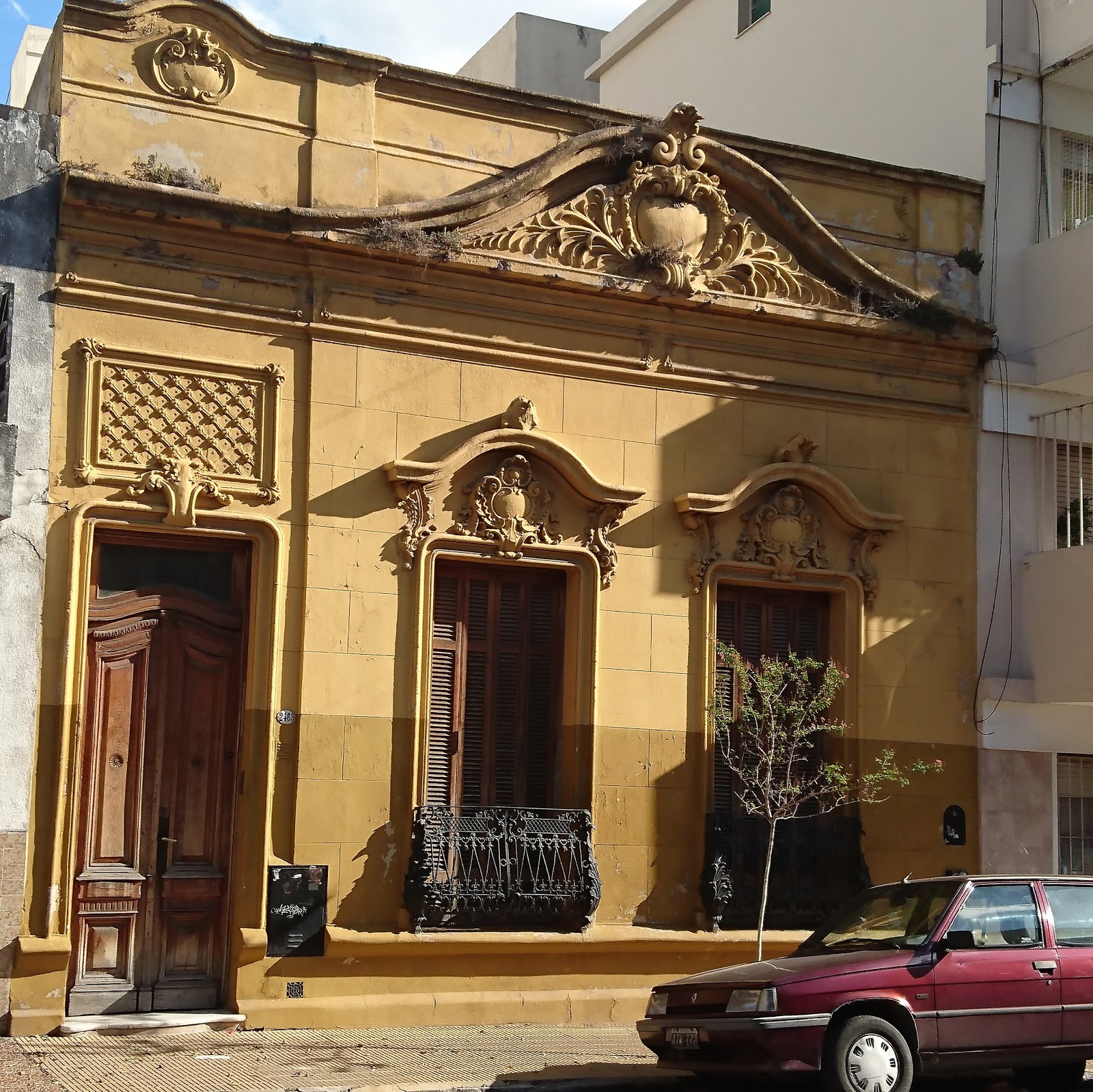
Of all the stories I have wanted to tell about my trip to Argentina, top of the list is the one about the ten days I spent at Juan and Josefina's. I wrote recently to Juan mentioning a friend currently in Buenos Aires. That correspondence and the fact that in Barcelona I will soon meet Hellen who was one of the house guests brought everything back.
During the trip I planned to stay in three different places all in the area of central Buenos Aires called Balvanera. I chose three places because I knew that if I became committed to one place I did not like for three weeks it would spoil the trip. I was curious, besides, to see different corners of the neighbourhood and to meet different people. I might have booked a place for the first ten days and chosen where to stay next while on the ground, but being alone, in an unfamiliar place very far from home and where I did not really speak the language I was cautious and did not in any case want to spend my time looking for accommodation. I wanted it planned out in advance and to know where I was going.
The house on Chile between Alberti and Matheu was the first place I stayed. In Buenos Aires people often omit the "street" or "avenue" part of a street name. It was walking distance to most of the milongas I had heard about. Janis gave me invaluable advice in this respect as on much else. She said: you need to be close to Entre Rios between Rivadavia and Independencia. So that is where I started looking, and no further west than Avenida Jujuy. I considered hotels, a studio, a tango house - all places people I knew had stayed. I nearly did book a tango house but I have had a lot of success with Airbnb and especially in Buenos Aires wanted to be around people with local knowledge. The first place I really liked turned out to be - though I did not know it then - a block away from Janis. She went to see it and sent photos of the neighbourhood together with much other useful information.
I liked my hosts immediately and soon trusted them. It was one of those instinctual likings that was, if anything, confirmed when Juan cautioned me in his polite, calm, explanatory way about security after I made a mistake with the door lock. After I left, an iron grille was installed on the door. I saw Juan much more than Josefina who works as an English teacher. So Juan had most to do with the house and tenants and came by usually in the late morning or early afternoon on many of those ten days.
The house on Chile between Alberti and Matheu was the first place I stayed. In Buenos Aires people often omit the "street" or "avenue" part of a street name. It was walking distance to most of the milongas I had heard about. Janis gave me invaluable advice in this respect as on much else. She said: you need to be close to Entre Rios between Rivadavia and Independencia. So that is where I started looking, and no further west than Avenida Jujuy. I considered hotels, a studio, a tango house - all places people I knew had stayed. I nearly did book a tango house but I have had a lot of success with Airbnb and especially in Buenos Aires wanted to be around people with local knowledge. The first place I really liked turned out to be - though I did not know it then - a block away from Janis. She went to see it and sent photos of the neighbourhood together with much other useful information.
 |
| Photo on the right by Janis |
I liked my hosts immediately and soon trusted them. It was one of those instinctual likings that was, if anything, confirmed when Juan cautioned me in his polite, calm, explanatory way about security after I made a mistake with the door lock. After I left, an iron grille was installed on the door. I saw Juan much more than Josefina who works as an English teacher. So Juan had most to do with the house and tenants and came by usually in the late morning or early afternoon on many of those ten days.
I often heard dance tourists say that "security is the same in Buenos Aires as as in any big city”. I did not much believe this before I went and when there could see plainly - and made a point of finding out - that it is not at all the same. Security was a big deal. I trusted three people on that subject: Chris in the UK and in Buenos Aires, Janis and Juan. I am glad they all in their different ways made their points.
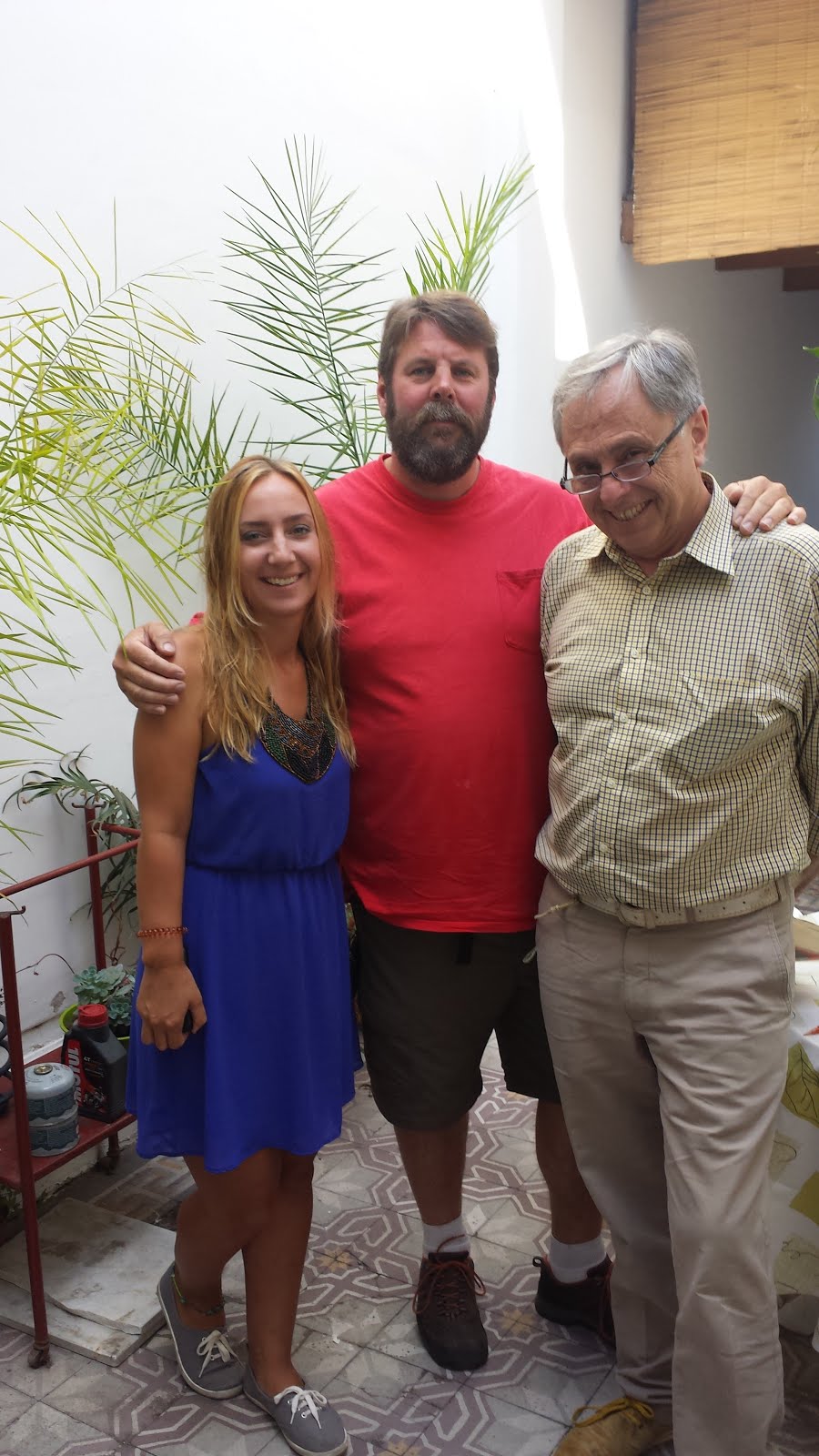 |
| Juan (right) with house guests Hellen and Bruce |
The same day I arrived, Juan and I were soon deep in a conversation about Buenos Aires, and the history and culture of Argentina/ This continued during my stay and afterwards because I met both him and Josefina after I moved on. I was delighted when Juan hailed me on Belgrano one day and we went for coffee in La Ochava. Josefina I met for coffee in a bar notable near her work in San Telmo and once near the end of my trip I took a friend to meet Juan and discuss property.
I was often offered strong, dark real coffee in the house. Chat with Juan ranged over topics such that it felt a bit like how it is to drink strong, real, unsweetened coffee. The photo above is the only one I had of him and I had none of Josefina until my friend Rianne went to meet them yesterday and took these. As I knew she would Rianne felt the same about the house. She said: I loved the place...those patios, the quietness. Juan was occupied with a guest when she visited but she said: I loved Josephine within a minute...like the ideal mother and so much more.
The house was simply a haven. I have said before that even with Janis' kind guidance, at first I found things in the city and the milongas confusing and disconcerting. It was a matter of being in a very different place with insufficient language skills for good independence and far from my children. But no matter how nervous I felt on the street, nor what happened in the milongas, the house was another world. There I felt relaxed, safe, secure and let the atmosphere there mend my confidence, frequently dented outside.
 |
| Rianne with Josefina |
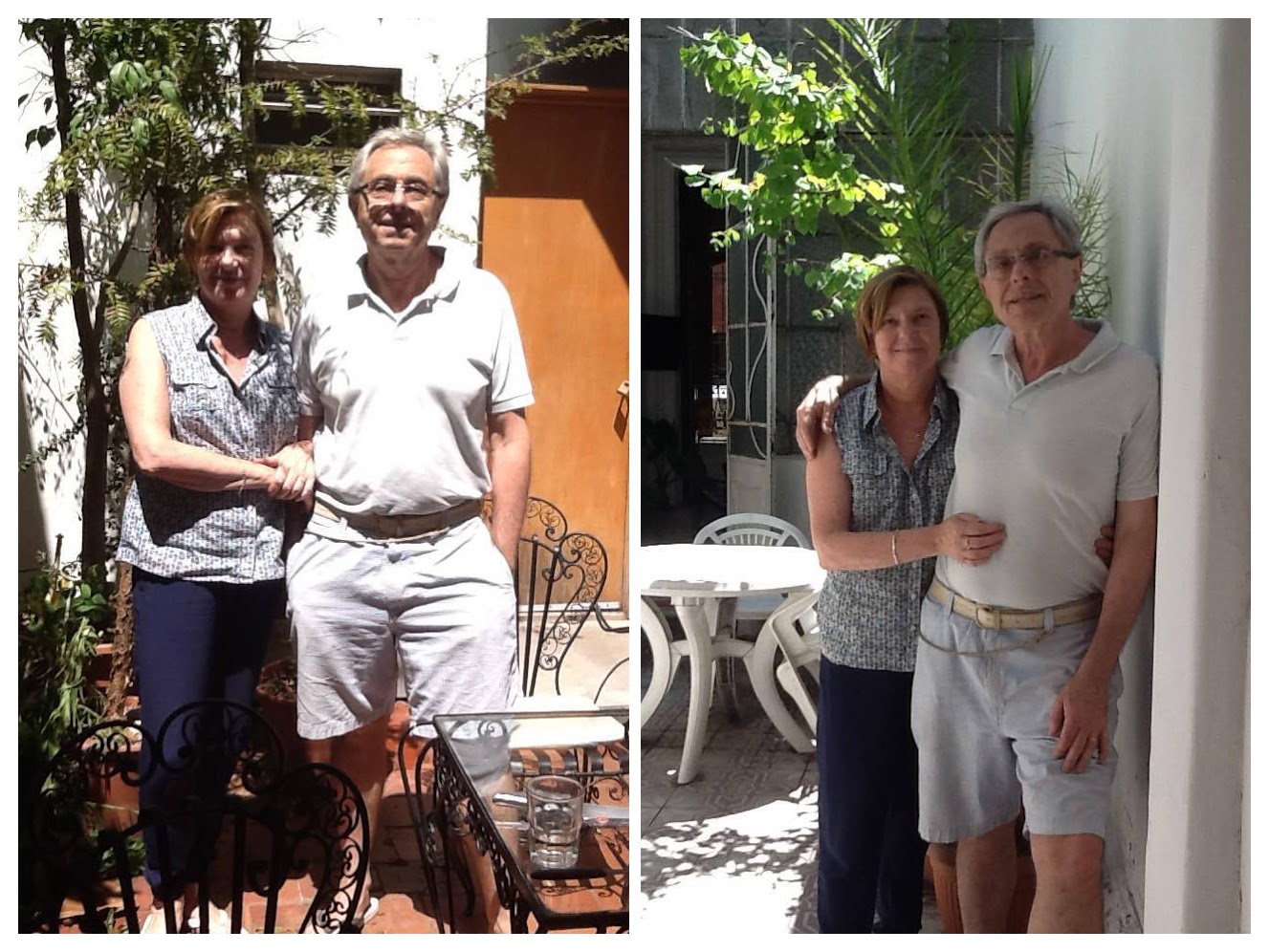 |
| Juan and Josefina |
The house was simply a haven. I have said before that even with Janis' kind guidance, at first I found things in the city and the milongas confusing and disconcerting. It was a matter of being in a very different place with insufficient language skills for good independence and far from my children. But no matter how nervous I felt on the street, nor what happened in the milongas, the house was another world. There I felt relaxed, safe, secure and let the atmosphere there mend my confidence, frequently dented outside.
During the day I wrote, often in the conservatory, or talked to Juan or other house guests or tentatively I went for shopping or cash or explored the streets or went on walking tours. Some afternoons and every night I went out with, strangely, fewer nerves, walking between the milongas and the elegant, unostentatious golden house that I was always happy to return to, often writing again at the desk in my room in the early hours.
 |
| Janis in the fruit and vegetable shop; Jose Luis (lower picture) |
The house was well located too. Janis showed me around the neighbourhood. She seemed so well-integrated in the neighbourhood. The street was quiet. Around the corner on Independencia there was a fruit and vegetable shop (also a butchers) run by lovely people, including Jose Luis who is learning English. The fruit and vegetables were excellent and cheap. I never found a shop I liked better for that. After trying the steak, most of the time I, like Janis, stuck to salads and fruit

There is a bakery nearby, and a health food store selling nuts and dry goods run by helpful brothers Martin and Ezekial. There is a well known bar notable, Bar de Cao on Independencia, an asador (for takeaway roast meat) three blocks west of there and the usual kiosks for phone and transport cards, regular supermarkets and Chinese supermarkets.
 |
| El Español |
There is a neighbourhooNot far away was a restaurant, which was recommended several times called El Español. I went once, near the end of my stay. The lassitude of the heat and many late nights, even for something as simple as preparing food, was stealing over me. I felt uneasy and conspicuous in a place packed with locals but the waiters were pleasant and correct, the food was nice and the portions huge. It was the only proper restaurant I went to for a meal apart from lunch with Janis in the must-see tourist trap of Cafe Tortoni when, out walking, we passed it. For the most part I made a salad once, sometime twice a day or ate empanadas from cafes. Only men I noticed tend to snack in the milongas. With so much novelty around to experience, with fruit and vegetables so good and freed from the requirement to cook for family, food held little interest. Between that, walking dozens of blocks (cuadros), daily and dancing I discovered when I got home and my mother greeted me appalled, that I had lost about a stone effortlessly. I was delighted.
The house was fifteen minutes walk to the milonga venues I seemed to frequent most often: Gricel to the south and west on Tuesdays and Thursdays and Obelisco, south and east on Mondays, Wednesdays and Fridays and walking distance to all the central milongas and milonga venues: El Beso, Plaza Bohemia, Nuevo Chique, Lo de Celia, Los Consagrados, El Arranque, Confiteria Ideal. Of these latter, I liked Milonga de los Consagrados best, on Saturday afternoon and evening in the airy venue Centro Region Leonesa.
The house on Chile was graceful, simply furnished, elegant with the beautiful tiles and the glass and ironwork so characteristic of Buenos Aires. I saw it used for a few hours as a set by a modelling agency.
 |
| Entrance towards conservatory |
 |
| Conservatory towards kitchen terrace |
 |
| Kitchen and terrace outside |
There were several connected terraces down one side of the house, giving on to the rooms. My room was large and airy and gave on to one of these terraces. I had my own large bathroom, a walk-in closet, an iron and ironing board and a large desk. I was initially interested in another room but took this room on Juan's recommendation and was glad I did.
 |
| My room and terrace |

 |
| Main living area |
Towels are not normally provided but being used to them provided in Europe I had brought none and they were given me. There was no washing machine available at the time I was there but there is a laundry service on the street nearby. My room had a fan but the house was cool and even in February I used it only occasionally. In the room there was a comprehensive and useful guide, a mix of tourist and practical information that my hosts had made for visitors. Lucy, trusted by the family for many years came to clean the house once a week.
Juan is an architect and he and Josefina, who teaches English and sounds like a gentle version of one of the calmer Radio 4 presenters, raised their family, now grown up, in the house. These days they live in another part of the city and the house on Chile provides rental income. They were and are keen to have tango dancers to stay. Juan’s father had danced, elegantly he said. Their children dance. Sometimes he goes to La Glorieta an outdoor milonga to watch.
It is hard to describe how nice it was to be around Juan and Josefina. Like the house, they are quiet, reserved, unostentatious. They are warm and kind, never overly demonstrative. It was a great antidote in some ways to how surprising the milongas could be to someone fresh from Europe. The men in the milongas in Buenos Aires can be lovely to dance with but trust some of them or give an inch in any sense that is not actually dancing at your peril. This includes what you allow to be discussed between dances, per "What does your husband do?" or even keeping hold of your hands between tracks. I was told by someone who knows him that a milonguero viejo had said the only truly correct subject for chat between dances was music. Sometimes I could see why.
Juan seemed to find particularly distasteful the broader problem of trust generally in Argentinian society and the related issue of corruption in Argentina. I was always aware how I was treated with genuine courtesy and respect by him and noticed how thoughtful he was of Josefina. It was so unlike the means-to-an-end respect one can sometimes sense in a milonguero. Juan listens attentively, is reflective and considered in his replies. Josefina is kind, non-judgemental and understanding. There is a sense of calm and of reliability about them. When George Eliot writes about the virtuous characters in her novels one has a sense of what at that time the contemporary examples of politeness, courtesy and kindness were like. That is how I think of them.
Juan seemed to find particularly distasteful the broader problem of trust generally in Argentinian society and the related issue of corruption in Argentina. I was always aware how I was treated with genuine courtesy and respect by him and noticed how thoughtful he was of Josefina. It was so unlike the means-to-an-end respect one can sometimes sense in a milonguero. Juan listens attentively, is reflective and considered in his replies. Josefina is kind, non-judgemental and understanding. There is a sense of calm and of reliability about them. When George Eliot writes about the virtuous characters in her novels one has a sense of what at that time the contemporary examples of politeness, courtesy and kindness were like. That is how I think of them.
Janis thought I was nuts to be going on anywhere else. Things were ideal. She was right but the other places were already booked and I did not like to cancel.
I also visited a couple of pleasant tango houses and heard about dancers, nice or interesting people, people I saw often in the milongas who had flats to rent or who hosted guests. Even so, I cannot recommend enough the house on Chile as a place to stay, so much more than just a place to stay.
Sunday, 19 February 2017
Janis

I probably would not have gone to Buenos Aires if it weren't for Janis of Tango Chamuyo. Two almost missable remarks got me there. How significant the small things can be, even from people we do not know. The first though was from Chris and happened in chat about music and dance:
F: I do mind them dancing tango to non tango tracks!
C: Well, I never have that problem. Because if I see them dancing non-tango, by definition they are not dancing tango.
F: :) You're such a literal guy. Do you not ever feel you make the world fit your view of it!?
C: Get thee to BA.
F: No way!
C: Fair enough, but then keep in mind that you and I are not viewing the same world.
F: Don't harry me! It would be lonely & scary & very likely demoralising & unsuccessful. I'm not ready. Let's not talk about it.
C: Sorry. I was not really suggesting, more making a point. Because it really is an important one. To people who really dance tango, those people "dancing tango to non-tango" are not dancing tango, even badly. They are dancing non-tango.
That conversation and others related to Buenos Aires dogged me for over a year, though I forgot about the "I was not really suggesting".
The second was something Janis said later in a reply to a comment of mine in her blog. It was something like "When you come and dance with the milongueros in Buenos Aires..." The remark just assumed I really would in a way I had not considered. It was after that that I decided, despite all the misgivings and the obstacles that I should go and soon, while there still were the milongueros Janis wrote about. Without Janis and her blog I probably would not have gone to Buenos Aires, or at least, not then.
But I did not know Janis except via her blog and I did not want to presume anything by contacting her and asking for advice. I remember that came up later, when I was there about something or other, I forget what:
- But you didn't ask! she said.
- I didn't like to! I said.
- I was expecting you to! she said
She is that ready to help.
This is how I got in touch with her. Once I had virtually decided to go to Buenos Aires Chris was the obvious person to ask for advice:
F: Have you advice about the trip, the stay, anything?
C: Top priority is security.
F: From mugging/street attack?
C: And the rest.
F: Is that common?
C: Yes, very.
F: Everywhere? I remember reading that Janis walks about at night.
C: Second priority is: ask Janis' advice. Esp. on good (inc. safe) accommodation. I would stay with an English speaker who understands [about security].
F: Do you know anyone?
C: Janis is the one to ask.
I had confidence in Chris and he, who is careful, had it in Janis. So I did. Still, I did not really expect her to answer a stranger, just as when eighteen months previously I hadn't really expected Chris to reply, when a year after first wondering where to find a copy of a foxtrot some guy had mentioned on the internet I finally contacted him to ask. I could not have been more wrong about either of them..
Janis when I met her was a force of nature. She is tiny, very petite and it was astonishing how much strength of mind, personality and will could fit in such a small frame. She was interested in everything and everyone related to Buenos Aires. She chatted to lots of people on the street, in shops, in the neighbourhood. She talked to babies. But she did not talk much in the milongas. There, she listened, she watched, she danced. In fact, though she might catch up for a few minutes with a friend here or there, she did not seem to like much chat in the milongas. Sometimes she introduced me to people or made an advisory remark.
Janis's blog is about other people. It celebrates other people. In her apartment she had lovely photos of her parents and I thought she should tell that story. She had an attractive collection of small objects. I think they were stones with words on them which were meaningful to her but I could see they also related to tango and to life and I thought that would make a lovely post. She seemed to see that too but she shied away. I don't really talk about myself in the blog was as much as she would say. And that is true. But there is no false modesty - she appears in photos with her friends, but her posts are about the city, the concerts, events, the milongas and the milongueros.
I cannot begin to say how kind and helpful Janis was. She told me so many useful things before I went to Buenos Aires I could not say them all here. She arranged for me to be picked up at the airport by a well known milonguero and came too. She showed me around the neighbourhood, lent me cash til I could get some and came with me to get money - luckily, as the place had moved. She went with me to the milongas in my first week, even showed me where the ones she didn't plan on going to were.
I already knew from the blog that she spoke her mind but I think many people admire and respect Janis for telling it straight, for saying what they would not necessarily dare to, for standing up for the manners and mores of the traditional milongas, for alerting foreigners to these and for keeping them up to date with the people and places they love to meet and to visit. The posts about the changes in the milonga Lo de Celia after the sad death of Celia are a case in point. It is well known how much Janis loved that milonga. It was the first one she took me to. We went three times in five days. Some of her posts talk about it like home and family but when it changed and became unrecognisable from what it had been, she moved on. She said she adjusted "faster than it took to walk from LdC to Obelisco. I put the past behind me and embraced a new tango home."
When we went out to the milongas, she always looked top dollar and she did it all on a shoestring.

Janis gave advice, told stories, answered questions and took me on an excellent walking tour incorporating history, tango and architecture. She kind of just said one day that was what we were doing and I am so grateful we did. She is knowledgeable about many aspects of Buenos Aires as well as about the milongas and the dancers.
She had thought I would blog every day about the trip but I said probably not, that I liked things to settle though even I did not expect it to take a year. I notice it is a year to the week since I went. She offered as soon as I arrived to arrange for me to dance with a famous milonguero in a private lesson. I did not want to offend her nor foreclose wonderful opportunities but I had to explain that these days tuition in tango was "against my religion".
I dreaded explaining this though I should have realised straight-talking Janis probably respected honesty. I felt if I gave in on that, even with a famous milonguero I would be faking everything I danced with him, withholding myself from the dance and lying about any enthusiasm or interest I showed. I would hate myself for that and it would be disrespectful to him. It had to be a real dance in the milongas or nothing. I didn't say any of that but Janis seemed to understand. She proposed something else with him instead, which was fine with me. She knew on this and other things, like her I had my own way. She just accepted it and let those things be.
I am not sure now if I would do the same again. Some men teach and make you "think dance" and you don't learn but some men just dance with you and you do learn. There is a big difference. But I still have a problem with paying someone for something that is about feeling between you. If you pay them it is necessarily going to be fake. On the other hand, I felt there is something wrong with a western tourist turning up expecting to learn for free from a milonguero in Buenos Aires. I am not sure I thought things through like like this at the time but I did feel things would get sorted out in the milongas.
Recently I told Janis I was going to write finally about the house I stayed in on Chile. A friend writing a book about tango was in Buenos Aires and it was bringing it all back. I asked Janis if I could mention her in the blog. She said "By all means, tell people that I live a block away and am available for walking tours, etc. I started a free and open tango class on Thursday from noon to 3:30 for anyone who wants to join me. I had understood it was a class for women and asked for clarification. She said, What started out as a women's only class is changing. We need men who want to learn. One woman asked if a friend can join us, and I said of course. I'm inviting friends who already dance to give the women practice."
As it turned out, my first dance in the milongas was with that milonguero but I was by then so keyed up and out of practice it was disastrous in that I felt stiff and embarrassed and in the spotlight. Though he was most courteous and invited me again later I finished it on the verge of tears at my nerves and inability to dance. While she might have been surprised that the world did not move for me, I guess Janis was not really surprised, given that I had turned down that opportunity to dance first outside of the milongas, to get used to new things. She is very clear-sighted. She didn't make a big deal of it. I imagine when Janis, talking about her new class says friends she means or includes Argentinians so I think her project sounds interesting. And I doubt it would be anything like a European class. Besides, the men dance very differently to a lot of dancing in Europe and if you are anything like I was when you first arrive, especially if you are alone then it might be a good thing to have that experience before going in to the milongas. Apart from that just meeting Argentinians is a lovely, warm, experience - and I liked too meeting other tourists and expats who come again and again to experience the milongas of Buenos Aires.
Janis is vegetarian. She lives very healthily. She looks amazing. Her indulgence is very dark chocolate, especially organic dark chocolate which is hard to get in Buenos Aires and can't be posted. The best I know of is from The Raw Chocolate Pie Company.
Even on that she thinks about others when she could have just considered herself. She wrote: A friend of a friend arrived a few days ago from the USA and brought along a box of Green & Black's bars which I ordered in August for my local health food shop. The guys were pleased to have 85% chocolate for their customers.
Monday, 18 July 2016
Lovely manners
It strikes me now, the good taste, the manners in the traditional, central milongas in Buenos Aires were generally much better than they are here. There was a kind of natural courtesy and respect that I think is aligned with the warmth of the people. I don’t mean the men - the behaviour of some of the men (and perhaps some of the women) can be something else. I mean some of the men can try it on in ways I have never seen in Europe. And some of the men can be harsh and very proud. And I know there are many problems in Buenos Aires, not least I sensed a deep lack of trust between people in society. But as a social group of men and women I liked the behaviour in the milongas.
I mean this: People do not talk when you are trying to arrange a dance, fewer guys walk up to ask for dances directly and if they are local I think they are thought of not as unaware of how things are done, but as sharks, preying on women who will tolerate that behaviour. Sometimes I have heard tourists report the excuse "The men tell us they do it because we don't understand cabeceo/mirada " but I think that a ruse. All the tourist women I saw were perfectly au fait with how things are done. After ten minutes in one of those milongas, how could you be otherwise? And most men know it.
They are polite in other ways too. People do not block your view during the cortina, they don't bunch together in corners to invite. Some of the women may be heavily made up and dress in ways that apparently attract men that we might not in Europe, or not as we age, but I cannot for a moment imagine women prostituting themselves on a stage to get dances the way I have seen women of the same age do at the multi-day events in Eton, or - admittedly younger - at Corrientes in London. Also, people don't take your seat.
I know the traditions, the structure of the milonga, how the seating is arranged and how you are given a seat to keep all help with these things. But why don't we do things this way?
I know many of us would like it. I know from the numbers who keep going back to Buenos Aires, from those I hear in internet forums who in fact like to get and keep their seat, who want a table for their drinks, who object when people block their view in the cortina. I know things are moving that way. I see it when I see good dancers attending milongas that are well-set up, with music and sound that is better than average. I know it is just a question of time. I know we are trying when organisers publish rules to make people behave in ways they think are more like Buenos Aires milongas. But rules are not the way. There are for example no "lanes" in Buenos Aires, there is just a ronda, moving like river.
It is the social habit that make the Buenos Aires milongas formal yet relaxed, structured, yet warm.
Saturday, 16 July 2016
Buenos Aires milongas: everything is different
What can you do when you are not dancing? You can watch and listen! There is so much to see!
Everything is different: how people arrive, how they are are greeted and seated; where singles, friends and couples sit, the birthday party groups; who changes their shoes and and where and who does not ; what people wear, how they have their hair and make up; what they do with their keys and bags; how they wait and watch; how they invite and accept; where and how they meet to dance; how they join the ronda; how they embrace; when they start dancing and how they dance; how and when they greet their friends; the signals they make with their hands; when they chat; the music, the tropical or otros ritmos tandas; what is permissible and what is not; how men interact with locals and with tourists...and neither type by any means come in one model. Even the ladies rooms are completely different there. When I was becoming more familiar with the milongas and paying more active attention to the tracks, dancers and DJs asked and laughed and joked but did not seem to mind me writing down tracks on napkins and scraps of paper. There is lots to do if you are not dancing - never mind figuring out which of the many guys there you want to dance with, which probably takes up most women's time.
Thursday, 23 June 2016
"And your husband?"
The only frustrating thing I found about this way of doing thing is that it can be hard to get the guy’s perspective on things to do with the milongas - but maybe I was in the minority in wanting that. I spoke a lot to women about those things but I did not know the guys, sat separately from them, was not staying in a tango house where such things might have been easier to find out and I was there for a short time so I spoke comparatively little to the men.
In the Buenos Aires milongas I went to most, chat between men and women sitting separately was on the floor, between tracks. Chat at this time is not my default tendency. If the music is great and my partner can dance then after a pause to breathe and go back into myself for a moment, all I want to do is dance and soon, to make the most of the music. Chat between tracks can continue quite a while. Even so (very traditional) convention is to talk only about music. Given the way guys can be over there, this I knew to be a wholly safe topic, one I was comfortable with.
Otherwise things might start with the (relatively) innocuous: What do you do? although even that when it happened to me felt fairly personal compared to the things most guys say. And no sooner that then: And your husband - what does he do? Within seconds you are on wholly different ground. That guy was clearly wise to those of us who, though married, do not wear a ring. But then some of the guys there believe - or perhaps they know - that once they know they have you in dance they may have more success in pressing an advantage.
Otherwise things might start with the (relatively) innocuous: What do you do? although even that when it happened to me felt fairly personal compared to the things most guys say. And no sooner that then: And your husband - what does he do? Within seconds you are on wholly different ground. That guy was clearly wise to those of us who, though married, do not wear a ring. But then some of the guys there believe - or perhaps they know - that once they know they have you in dance they may have more success in pressing an advantage.
But the opening question is nearly always De dondé sos? In the great cacophony of chat that erupts in the room and if you are softly spoken it could easily take until into the next track for your partner to understand where you are from. The standard questions which follow are: Hablás castellano? Pero entendés castellano? Te gusta Buenos Aires? And after that, though you may not have had the conversation you might have liked you have at least survived the basic small talk. They could well ask Es la primera vez acá? - whereupon you realise they sussed you long ago...
Wednesday, 22 June 2016
No chat?
The question of how you can chat when when your seat in the milonga is fixed preoccupied me before I went to Buenos Aires.
It is true there are milongas where there is no fixed seating and in theory if you knew people you could I suppose chat to them. I tended not to go to places without fixed seating.
I worried whether I would chat at all, anywhere. But no, even with my wretched Spanish I did not for a moment find chat a problem in Buenos Aires inside nor outside the milongas. I chatted for hours to hosts or travellers in my accommodation, to other dancers, people who owned or worked in accommodation for dancers, to locals, expats, tourists, milonga hosts, bar staff, Ladies room attendants, DJs, tour guides, people on tours, people in shops and kiosks, bus drivers, taxi drivers, subway attendants, even passengers on public transport - or rather they occasionally said things to me. In fact, all the things I worried about (and what did I worry about beforehand - how to pay for drinks?) were not the problem. Things I had not anticipated were more difficult but overall problems were relatively few.
Still, before I went I worried: what if no one chooses me? What if I sat conspicuously not dancing for hours? In those circumstances, how would I, who loves to chat, who loves to meet people, who loves the random conversation had by chance, how would I sit all night next to women I might not like and probably couldn’t talk to in Spanish even so? And who knew if they would want to chat? But these were not generally problems either:
Even if you do not chat, there is a lot to observe and listen to in the milongas. The Buenos Aires milongas besides are so very different to the European milongas I have been to that there is even more to observe than is usually the case. Many women do not chat, choose not to chat, maybe because there is so much to see and hear.
When you are given a seat at a table or even when you enter the Ladies I found it normal to acknowledge everyone and say hello. And that might be all the interaction there is, especially if there is already a group at the table. Women may not necessarily start talking to you. Perhaps they are a bit put off by these closed northern types coming to their milongas and interacting so nervously and differently to the way they do. Yet the default position of most, possibly all local women I found to be kindly. I often started conversations with a question, made friends and discovered many interesting things. People seemed to appreciate my lamentable efforts in Spanish - and sometimes switched to English.
Still, it does happen that you are sitting with people you cannot talk to or do not want to talk to and you are not dancing either and you have perhaps watched for a while already. At these times, even well before this point it is normal that you may want to chat. Occasionally I saw a woman, generally a tourist I did not know but had maybe seen before and was curious to meet. Or, more likely, I saw someone I knew - often a local or an expat, or they saw me. You can talk to people not at your table as you pass theirs when you arrive, when you leave, when you go outside for air or to and from the bathroom. I saw relaxed local couples greet friends on the way to or from the floor or between tracks as they happened to part from the embrace beside people they knew. Or you can perch.
For the record, perching is not a term I ever heard. But perching happens after the tanda starts when it is looking likely that the majority of invitations are over. If you then see your friend or they see you and, say, you are both alone, one of you can go and talk to the other for a track or even the rest of the tanda "perching" while the chair next to them or next to you is free if the person who occupied it is dancing. I think this is female nature among many of us, but perhaps not all. Perhaps too it is a complete faux pas but I saw this happening and did it too. This applies I guess more to the women. Men move around more - to the bar, some lounge about or stand but I think women are more focused and specific in where they go, in how they move around the milonga because in the traditional milongas women do not move randomly about and certainly they don't just (apparently) casually hang out around the salon the way people can do in Europe. But when the tanda ends you have to leave whoever’s chair you are perching on before they get back to it. You cannot just swap seats in the milonga - not even at your table. When you are given a seat at a table you are given a fixed position at that table. Having said that, there are exceptions. I gave up my seat once to stay chatting to a friend well after midnight in Gricel but at that time there were more seats empty than taken.
After people have sat down and are looking for their next dance, their neighbours do not talk to them to give them opportunity and focus to do this. This is surely just good manners and it mystifies me that it is only partially observed and only in some milongas here because after all the cortina and the start of the next track only lasts a short time.
Subscribe to:
Posts (Atom)