Showing posts with label Implicit learning. Show all posts

Wednesday, 21 September 2016

Gardens


"Abu Wad's whole existence seems dedicated to the beauty of life"

About the time my first son was born I used to look for quiet streets in Southwark to take him out for walks. Invariably, on the way to or from walks along the South Bank we would go along the unpromising Redcross Way in the middle of which was a small haven of peace and green and growth. This garden was founded in 1887 and almost lost during the twentieth century until it was rescued and revived the year before my son was born. A garden relies on insight and creativity, love, nurturing and persistence and often help from like-minded friends. Well over one hundred years later, though small, it is still giving sanctuary and pleasure to people every day. It was at this time I first thought what a special legacy a garden is. 

Nearby, there used to be a mysterious locked gate with things tied to it. Behind I remember nothing but wasteland, like a building site but there must have been a sign somewhere because I knew centuries ago it had been a burial site. I wonder if the guerilla gardener who planted here was inspired by the Red Cross Gardens because now I see Crosssbones has become a garden itself.


This is another community garden made by volunteers in Dunkeld, near me. I recommend the village also for the views of the river, the cathedral, and especially the surrounding walks. 


All gardens are restful and re-energising, even - sometimes especially - those in the centre of a city.  And yet gardens, living testaments to creativity and care exist in such variety. These are just a few of those I have seen this year, often with my children.
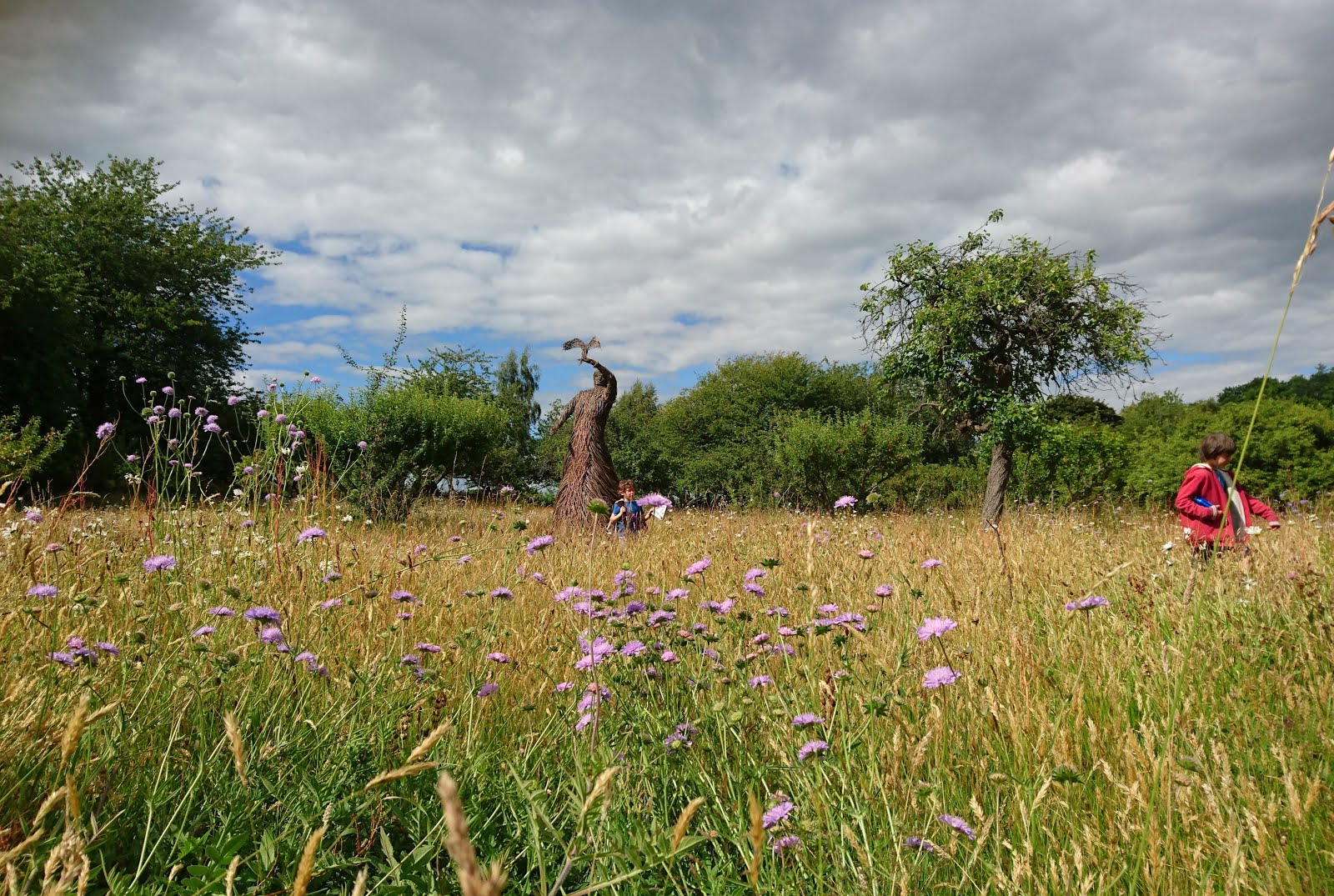
The magical orchard and meadow at Falkland,  full of cherry trees


Centre of the maze, Falkland Palace, Perthshire
Beech maze, Scone Palace
Drum castle, Aberdenshire, which has quadrants of historic roses
Gardens recommended to me between Jujuy and Independencia, Buenos Aires


Wildflowers planted on a verge opposite some houses, Auchteragven

Willow room and tunnel, New Lanark

Teehaus in Weissenburgpark

This short film about the last gardener in Aleppo, contains so much.  Many will, like me, find it distressing but it is also about an inspirational man who, like many gardeners seems to have improvised with what was to hand and turned all circumstances to his advantage. He had faith in life and beauty and saw new life growing even as his garden was damaged by war.  He saw a way forward, a meaning and purpose in the most chaotic, dangerous and difficult conditions.  I listen to his words: "music", ordinary people, help, beauty, nourishment, life. You can tell so much about someone just from the words they use. Despite his death and the obvious personal tragedy for his son, he lives on and in the best way. 

For me so much of value in life and the things that help us decide how to live is found during time spent in gardens but also in stories shared and in conversation. Although his circumstances were so different to mine and although he speaks for only a few moments in that short time I learn so much about beauty, hope, love, wisdom, courage and great strength of character. 

And also, that if you make the right conditions and if you believe that it is possible, not only can beautiful things can grow in the most unpromising places where others would never believe it is possible but when people see what is possible some of them go on to plant too. Because while a plant growing is miracle enough, what is planted is never only a plant. 

Tonight my son asked for a second story. It was late and I said one was enough but he begged.  And time with our children is so short, especially time of this sort and you never know for how long you can enjoy such grace and good fortune, so how can you refuse?  He brought this:


It is the tale of a thief who does not initially realise what she has stolen. But, on opening the bag of acorns realises there is a forest in her arms.  She becomes someone who transforms grim roundabouts and dark cities. 


And I think this story is about the change within ourselves, which can be an awakening or a struggle, when we realise things about which we may have been unaware or mistaken.  It is about when we understand where value lies and we continue to pass on what we have learned - quietly, by planting and letting things grow.


Friday, 5 August 2016

Cortinaless

Today, I came across a discussion in an online group about practicas - there was a query about why women were not attending which although I don't know this practica I tend to find is because the guys aren't nice to dance with. There was a worry from an organiser that perhaps events may not run without sufficient support. There were some calls for "no cortinas" from women not getting dances and for men to be more generous with themselves. There were cries to the contrary too - about dance being a pleasure, not a chore. I said I would rather die than accept or give something as patronising and demeaning as a charity dance. But there's nothing "charity" about dancing with beginners for me - it's often a great pleasure.

Increasingly I avoid practicas without cortinas. The music tends to be poor and attracts people who care about moves more than music. 

I feel music in tandas and find it uncomfortable when a partner I'm dancing with hasn't heard the change of orchestra. They may expect to keep on dancing but for me a change of orchestra is a natural end point, signifying a change of partner or a pause. Cortinas make thing clear and easy without anything being said - just like invitation by look. 

There is nothing about tandas with cortinas that prevents anyone from dancing the last one or two tracks whereas to take away the advantages of tandas with cortinas from those who enjoy them will increase the likelihood of such dancers escaping this discomfort by going elsewhere. Some choose who they invite or accept and when. Others try to make them dance with more people through such tactics as "no cortinas" or gimmicks like "move on one partner" which luckily is increasingly less common. 

Cortinaless practicas detract in several ways but how do cortinas detract except by some thinking others are having more fun than they? It isn't logical to think having no cortinas mean people will dance with you more. If someone doesn't want to dance with someone else, what difference do cortinas make? The only thing no cortinas does is cave in to the demands of people who can't get dances for a single "pity" dance which is so embarrassing as to be almost unanswerable. No cortinas doesn't make it more likely that someone will dance with you except by making the indignity obvious that they may grant you one track but couldn't bear to do three.

I really feel for women who can't get dances or the dances they want - because very often that person has been me!   I don't know what to say to that except that in my experience things get worked out in the milongas, one way or another. You find out eventually what it is to be nice to dance with, you find out who you trust to find those things out with and who you don't because trust in dance as in conversation is all there is really.  And these things just can't be forced, least of all "encouraged" by well meaning people with the wrong end of a very delicate stick.

If I want to dance one or two tracks with a woman or I think that's all I might get from her on a first shot, I'll invite her at the end of a tanda - or I might be so invited. It makes things clear with nothing having to be said: "I'm not sure enough about you to dance a whole tanda, but do you want to give a couple of tracks a try?" Even that can be a fairly unsubtle, patronising and insulting thing to do. It can imply "I don't know if you're good enough for me" though it could also mean "You may be out of my league". Either way, such a risk might not be worth taking. 

Usually - though not always - I dance tandas. Surely the only time you might tend to dance one or two tracks is if you don't know someone or the music is poor for part of the tanda. Dancing a single track or even two there is no time to get to know someone, to get over nerves, or perhaps one of the tracks wasn't the best so you didn't dance well. With the traditional four tango tracks to a tanda there is time to get a good idea about somebody, particularly a nervous somebody, time to adjust and accommodate or lose your own nerves in the pleasure of the music and the new partner.

Places that lose cortinas are likely to also end up losing the dancers who have no trouble getting partners and who enjoy the natural rhythm of tandas with cortinas. The dancers who demand no cortinas of hosts may wish for that but ultimately it results in a two-speed community where, in general, the better dancers will dance in a different local milonga with people who can dance and who prefer tandas and cortinas and those who can't get dances won't go. They will go to the cortinaless practicas they wanted, to dance with...others who can't get dances or who like the off-on, stop-start emptiness of single track dancing and where, really, is the fun in that?  Or, those who can dance will and do travel away from such places or stop dancing if their circumstances prevent travel. 

In contrast, a healthy milonga has good music, tandas and cortinas; good physical milonga conditions like seats, tables and good lighting for invitation by look; a naturally pleasant host who helps create the kind of floorcraft that attracts good dancers and an atmosphere without overt rules which is as relaxing as the music such that good dancers will naturally dance with new dancers. All this happens in the real conditions of a real milonga.  I think it is in these kinds of places that new dancers grow, experienced dancers develop and everyone has a good time not in some cortinaless false kindergarten-like simulacrum of a milonga.
   .
I am not against practicas at all though I notice better dancers will usually prefer a milonga if they have one so the trouble with practicas can be insufficient experienced dancers to dance with newer dancers.  For me, good practicas are just less formal milongas where people can try things out in the middle without getting in the way of others, or dance with a smaller group of more known people, where they feel safer.

A good practica might be a little different to a milonga.  But to be a real practice, a practice for a milonga it would, obviously, be very close to it which is another reason it would have cortinas.  But maybe in a practica it would be OK to stop and start and try things out, to talk (but oh, please, still not lecture new dancers) on the floor. Men can learn how to dance by dancing in the traditional woman's role with experienced partners of either sex. Men would feel less self conscious about this than in a milonga - until it becomes more common and therefore more natural for men to learn this way, rather than by learning set moves in class.  That makes most of them  unpleasant to dance with and worse makes them treat women as little better than performing dogs to jump through hoops. If your practicas are full of men like this, little wonder when women do not go. 

Most women are nicer to dance with than most men. But when men can dance, even more women become nicer to dance with, just like that.  

Yet it is perfectly possible for brand new women to learn to dance with good partners in milongas.  It happens all the time.  Such women are easily the nicest I dance with and the most unspoilt by class contrivance.  So if women can learn this natural way, why can't guys swap roles and learn that same way too? Because guys who know what dancing like a woman feels like are so much nicer to dance with.  I'm not saying there's no place for a practica, just that everyone, everyone can learn and enjoy an awful lot implicitly in a good milonga - and often hardly even notice the learning.

Sunday, 10 April 2016

Standardisation and individuality

Social dancers, taken by multi-talented Adam Szczepańskibased in Aberdeen.

On my bedroom wall a “handbag" hangs on a hook.  It is made from two pieces of paper stapled together to which is attached a paper strap. On the front my my elder son has drawn a picture of a bridge, a river, fish jumping, ladders up trees and a flying fox over the river. On the front it says "To Mama".  In this I keep all the the little notes full of love (and bedtime procrastination) that they have brought me.  They are probably the most treasured items I have.

When I think about what is precious in life, it is the time I have spent with family and friends. It is also in things I see or hear that have been created and are original, particular, individual, personal. 

 I see it also in nature, or in the games we play. Both of these use something like templates but each time the game is played it is different, each time the seed grows into a plant, it is similar to others of its species but different in its variety.


I see asimilar quality in museums and historic properties and in the performance of drama or music:


I believe it is in the gardens people create, in how we decorate our homes. in the learning we choose to do and in the food we make.


In material things, I find it in the architecture unique in its design or setting. It is in art, in sculpture, installations, in photography, graffiti, design. 


It is in the cards and presents and costumes we make. I see it even in face-painting, tailored to the child.


I feel it part of the milongas and dances we go to and the parties we throw...


I see it in both simple things made by people I know and love or in rustic things made by others... 


 ...as well as in elegant or sophisticated things made by strangers:


They all seem to me individual in some way.

I do not find this in chain store shops or in chain-type attractions.  Whatever was originally created in these mass produced material goods has lost its charm somehow. I find it in things that are not part of a general trend towards process, control, mould-made and standardisation.

What is dancing tango? So many class advertisements today scoff now at teaching moves or steps, let alone patterns or sequences. That I think is a good thing.  So now they focus on "the basics".  If anything though this can be worse since it usually seems to include teaching "How to embrace" or the slightly more subtle versions: "How to connect" or just "Connection".  Sometimes it comes under the conveniently vague term:  "Technique".  However it is phrased I see it as an attempt to standardise and interfere with something unique between two people.  How could anyone have the sheer face to industrialise something special that happens each time a couple chooses one another and embraces?  How could anyone in class hope to achieve such a thing through partner rotation where indeed there is no such choice at all?  How could people in class even have any inkling of what that kind of improvised, individual dancing is really like given the conditions in a tango dance class?

I think some things can be imparted, shared, implicitly learned better than they can be explicitly taught and I think this is true of dancing tango. Otherwise, tango dance class is like trying to industrialise, to fabricate something where the value is in its handmade quality. It can be no coincidence that “fabricate” has two meanings - to make, especially to make something inauthentic, but also to lie.